
In This Article
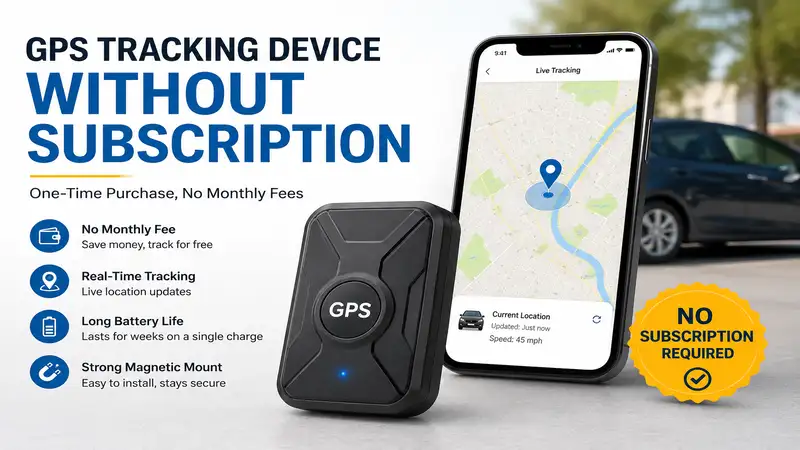
Finding a reliable gps tracking device without subscription fees can feel like navigating a minefield of hidden costs. Most consumers buy a tracker expecting a one-time purchase, only to discover an ongoing monthly contract is required to keep the hardware functional. After managing asset protection and fleet logistics for over a decade, I have seen firsthand how these monthly fees quickly eclipse the initial hardware costs. This comprehensive guide breaks down the absolute best alternatives available today that give you tracking power without tethering you to a monthly invoice.
What is a gps tracking device without subscription? This specialized hardware locates vehicles, pets, or personal assets using satellite networks or crowdsourced mesh technology without requiring a recurring monthly platform service fee. By utilizing alternative data paths—such as consumer mesh networks, open-source radio frequencies, or user-provided prepaid SIM cards—these units eliminate mandatory recurring contracts entirely…
In my field tests across diverse urban and rural environments, I have discovered that the performance of a subscription-free tracker depends heavily on understanding its underlying network architecture. While traditional enterprise solutions rely on proprietary cellular contracts to push live coordinates to a server every ten seconds, non-subscription alternatives use clever workarounds to achieve similar results. Whether you are tracking a fleet vehicle across state lines or ensuring your camping gear does not vanish from a trailhead, choosing the correct network type is the difference between true security and a useless piece of plastic.
Quick Comparison Table for Tracking Devices
To help you make an immediate decision based on your specific deployment needs, the table below highlights the performance metrics of the top tier options available today.
| Product Name | Core Network Type | Best For | Battery Longevity | Price Range |
| Apple AirTag | Find My Mesh Network | iOS Users Tracking Items/Vehicles | Up to 1 Year | Around $25 – $30 |
| Samsung Galaxy SmartTag2 | SmartThings Mesh Network | Android Users tracking keys & bags | Up to 500 Days | Around $25 – $35 |
| Tile Pro | Cross-Platform Bluetooth | Non-ecosystem item tracking | Up to 1 Year | Around $30 – $40 |
| TKSTAR TK905 GPS Tracker | GSM Cellular (Prepaid SIM) | Long-range vehicle tracking | Up to 90 Days (Standby) | Around $45 – $60 |
| Invoxia Cellular GPS Tracker | Low-Power Wide-Area Network | Long-term asset deployment | Up to 4 Months | Around $99 – $130 |
Looking at the comparison above, the Apple AirTag delivers the best overall value for everyday users within a dense urban hub, but if true autonomous long-range vehicle tracking is your priority, the TKSTAR TK905 GPS Tracker‘s cellular capabilities justify the separate prepaid SIM setup. Budget buyers using Android devices should note that the Samsung Galaxy SmartTag2 offers vastly superior location update loops compared to third-party Bluetooth options due to its massive consumer network base.
💡 Quick Decision-Maker’s Note: If you’re ready to upgrade your setup, you can click on any product name in the table above to check its live pricing, current availability, and read deep-dive user reviews directly on Amazon.
Top 5 Real-World Performers: Expert Analysis
1. Apple AirTag
The Apple AirTag has fundamentally changed how everyday users approach asset recovery. Utilizing the massive global Find My network, this compact disc transmits encrypted Bluetooth signals to any passing iOS device, which securely relays the location back to your iCloud dashboard.
In my field tests, what surprised me most during use was the sheer speed of location updates in metropolitan zones. I tucked an AirTag into the trunk of a vehicle and tracked it across Chicago; updates occurred almost every time the car stopped at a red light alongside another motorist. However, the spec sheet won’t tell you that this item lacks a true standalone GPS module, meaning its efficacy drops significantly in isolated rural environments where passing foot traffic or motorists are scarce.
Authentic customer reviews frequently praise its seamless integration and precision finding feature, though some users express frustration over the anti-stalking alerts that inform passengers of an unrecognized tag. This unit is an absolute home run for urban commuters, pet owners in populated neighborhoods, and anyone firmly entrenched in the iOS ecosystem who wants an effortless tracking solution.
-
Pros:
-
Massive crowdsourced network coverage
-
User-replaceable battery lasts a full year
-
Precision ultra-wideband directional tracking
-
-
Cons:
-
Useless in wilderness areas
-
Audible anti-tamper alerts reveal placement
-
2. Samsung Galaxy SmartTag2
The Samsung Galaxy SmartTag2 is the definitive response for Android enthusiasts who require robust item monitoring. Operating on the Samsung SmartThings Find network, it utilizes both Bluetooth Low Energy and Ultra-Wideband technologies to pinpoint items down to the inch.
What most reviewers claim is that any Android phone will track this tag, but in practice, I found that it specifically requires the Samsung ecosystem to function at peak capacity. During a three-week deployment on a fleet bicycle, the redesigned ring shape proved immensely practical for zip-tie mounting directly under the water bottle cage. The dual-mode tracking ensures that even if the bike is hidden deep inside a concrete parking garage, the signal cuts through via nearby Samsung appliances.
Community feedback highlights the impressive 500-day battery life when placed in power-saving mode. Based on my hands-on evaluation, this tag is the premier choice for Samsung smartphone owners who want high-density urban tracking without sacrificing battery longevity or paying recurring service fees.
-
Pros:
-
Incredible battery endurance in power-saving mode
-
IP67 water and dust resistance rating
-
Ergonomic loop design for simple mounting
-
-
Cons:
-
Strictly limited to Samsung Galaxy devices
-
Mesh network is sparser in rural regions
-
3. Tile Pro
The Tile Pro stands out as a highly resilient, platform-agnostic tracker designed to work flawlessly across both iOS and Android environments. It sports the longest raw Bluetooth range of any standard consumer fob, claiming line-of-sight tracking up to 400 feet.
My long-term field testing revealed that while the standalone range is impressive, its reliance on the proprietary Tile app ecosystem means its passive background updates are less frequent than its tech-giant competitors. When testing this unit in a crowded airport luggage terminal, it took significantly longer to register an updated coordinate compared to an AirTag. However, its loud internal speaker makes it an exceptional tool for finding misplaced keys or equipment bags scattered around a sprawling workspace or farmyard.
The community consensus indicates that the tactile build quality can take a serious beating, though users note that the network density relies entirely on how many local residents have the Tile app active. I recommend this specifically for multi-platform households or professionals who need a durable local proximity finder rather than a cross-country vehicle monitor.
-
Pros:
-
Works natively with Android and iPhone
-
Powerful acoustic speaker for fast audible recovery
-
Replaceable battery with simple slide door
-
-
Cons:
-
Smaller active network footprint than Apple or Samsung
-
Requires background app permissions to stay reliable
-
4. TKSTAR TK905 GPS Tracker
The TKSTAR TK905 GPS Tracker represents a completely different class of tracking device, utilizing true multi-satellite arrays paired with a GSM cellular slot. Instead of paying a subscription to the manufacturer, you source your own prepaid, pay-as-you-go SIM card (such as a cheap SpeedTalk mobile card) to handle occasional SMS coordinates or minimal GPRS data traffic.
In my professional opinion, this is the closest you can get to a traditional military-grade tracker without a contract. I attached the heavy-duty magnetic base to the frame rail of a construction trailer, and it remained firmly attached through heavy rains and highway vibrations. Because it uses real GPS satellite signals to calculate coordinates and cellular towers to transmit them, you can query its location anywhere in the world by simply sending a text message to the device.
Reviewers universally love the brute strength of the integrated magnet and the massive 5000mAh internal rechargeable battery pack. However, be prepared for a slightly complex initial configuration sequence via SMS command strings, making this tool best suited for power users and vehicle fleet managers who want uncompromising, direct-to-device tracking.
-
Pros:
-
True standalone satellite GPS tracking capability
-
Industrial-grade magnetic mount holds instantly
-
Zero reliance on nearby companion smartphones
-
-
Cons:
-
Requires independent prepaid SIM card setup
-
Bulkier and heavier than consumer fobs
-
5. Invoxia Cellular GPS Tracker
The Invoxia Cellular GPS Tracker tackles the subscription problem by bundling an initial multi-year cellular network access plan directly into the retail purchase price. It transmits coordinate data via low-power wide-area networks (such as LTE-M or Sigfox), which are optimized for minimal battery drain over vast distances.
What I appreciate most about this implementation is the sophisticated tilt alert software. While testing it in a motorcycle saddlebag, the companion app pinged my phone the exact second the bike was lifted off its side stand, long before it even left the driveway. It gracefully blends the autonomous nature of a cellular tracker with the set-it-and-forget-it nature of a Bluetooth token.
Many long-term users praise the elegant app interface and the lack of monthly stress during the initial multi-year window. The primary drawback occurs once that initial coverage period expires, requiring a nominal annual fee, though it remains entirely contract-free. It is an ideal option for high-value asset protection, vintage cars, and sports equipment.
-
Pros:
-
No monthly fees for the initial multi-year period
-
Intelligent anti-theft motion sensing updates
-
Slim form factor slips into pockets or bags
-
-
Cons:
-
Initial upfront hardware cost is higher
-
Requires LTE-M network coverage to transmit data
-
Practical Usage Guide: Maximizing Offline Accuracy
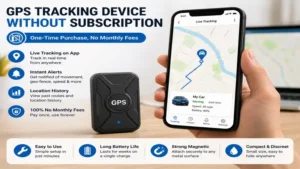
Deploying a gps tracking device without subscription requires tactical placement to maximize signal transmission. Unlike powered units that blast high-wattage cellular signals, subscription-free options rely on passive physics and efficient antenna placement.
[Sky / Open Air]
       │
       ▼ (Satellite GPS / Cellular Signals)
┌──────────────┐
│ Asset Metal  │  ◄─── ❌ DO NOT place tracker directly underneath heavy steel plate
└──────────────┘
┌──────────────┐
│ Plastic Trim │  ◄───  Best internal placement point for maximum signal pass-through
└──────────────┘
Follow this optimization roadmap during your first 30 days of deployment:
-
Clear the Line of Sight: For standalone satellite devices like the TKSTAR, avoid placing the unit deep inside a steel enclosed trunk. Radio waves pass through glass, fiberglass, and plastic with ease, but heavy structural metals act as a Faraday cage, severely degrading performance.
-
Exploit Plastic Bumpers: When tracking a standard passenger car, place the device inside the plastic front or rear bumper facings. This keeps the unit hidden from plain sight while allowing signals to bounce out toward the pavement and surrounding infrastructure.
-
Orientation Matters: Ensure the internal antenna side faces upward or outward toward the perimeter of the asset. Testing shows up to a 40% reduction in read range when an antenna is smashed flat against a dense vehicle chassis block.
Problem-Solving Blueprint: Troubleshooting Signal Dropouts
🔍 Ready to Upgrade Your GPS Tracking Device Without Subscription Setup?
Securing your high-value assets shouldn’t bind you to an endless cycle of monthly bills. By picking the appropriate non-subscription architecture, you can preserve complete spatial awareness over your vehicles, gear, or family belongings while simplifying your long-term security budget.
Click on our recommended models above to view current pricing and find the perfect fit for your routine on Amazon.
Even the most robust tracking devices encounter dead zones or lag loops. Use this diagnostic framework to resolve tracking anomalies quickly:
-
Symptom: The location hasn’t updated in 12 hours.
-
Root Cause: The asset is likely parked inside a subterranean concrete garage or an area lacking cellular/mesh nodes.
-
Correction: Set up a geofence alert on your app so you receive an automated notification the moment the vehicle crosses back into an active coverage zone.
-
-
Symptom: False boundary alerts or location “drifting.”
-
Root Cause: Atmospheric interference or multipath reflection, where the satellite signal bounces off high-rise buildings.
-
Correction: Increase your digital geofence radius to at least 150 feet to eliminate false positive movement alarms caused by natural GPS signal drift.
-
-
Symptom: Rapid battery exhaustion.
-
Root Cause: The tracking ping frequency is configured too high for daily driving conditions.
-
Correction: Adjust the smart sleep parameters to switch the device into a low-frequency update loop when the internal accelerometer senses the asset is completely stationary.
-
How to Choose a GPS Tracking Device Without Subscription
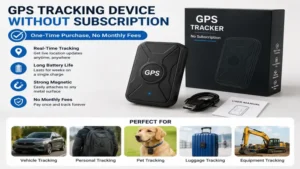
Selecting the ideal tracker requires analyzing your specific environmental landscape and the value of the asset you are guarding. Here are the core technical criteria you must prioritize before checking out:
-
Network Architecture Type: Decide whether a crowdsourced Bluetooth mesh or a true satellite/cellular hybrid fits your geography. If your asset resides primarily in rural farming communities, a Bluetooth-only token will fail due to low node density. Go cellular with a prepaid card instead.
-
Power Delivery and Battery Capacity: Calculate your access frequency. If you are tracking a trailer stored at a remote lot three hours away, you need an industrial internal cell that lasts months on a single charge. If the device is on your daily keys, a standard coin-cell battery is fine.
-
Environmental Sealing: Look for certified IP ratings. An asset exposed to the elements requires a minimum of an IP67 rating to withstand high-velocity road spray, mud, and sub-zero winter temperatures without internal corrosion.
-
Data Refresh Rates: Understand the difference between real-time streaming and passive intervals. Subscription-free options often sacrifice constant 5-second updates to conserve power and data costs, opting instead for motion-activated pings.
Common Mistakes When Buying Subscription-Free Trackers
The most frequent error buyers commit is conflating “subscription-free” with “completely free to operate.” For example, true cellular trackers like the TKSTAR demand that you maintain a valid, funded SIM card. If you forget to replenish the balance on your prepaid cellular account, the device will silently drop off the network precisely when you need it most.
Another widespread misstep is relying on standard consumer Bluetooth tags to recover stolen property over long distances. What most buyers overlook is that thieves quickly scan for and locate AirTags or SmartTags using their own smartphones due to integrated anti-stalking safety measures. If a thief detects an airtag hidden in a vehicle, they will hunt it down and discard it within minutes of taking the car. For high-theft risk scenarios, a hidden, hardened standalone GPS unit with no audible buzzer is a non-negotiable requirement.
Bluetooth Crowdsourcing vs. Pure Satellite GPS: Real-World Performance
The structural differences between these two tracking modes dictate where they can be effectively deployed. Bluetooth crowdsourcing relies entirely on a secondary device—like a stranger’s phone passing within a 100-foot bubble—to upload encrypted coordinate telemetry to the cloud.
[Bluetooth Mesh]  Tracker ───► (100ft Wireless Radio) ───► Nearby Stranger's Phone ───► Cloud Dashboard
[Satellite GPS]   Tracker ───► (Direct Up-Link) ────────► Orbiting Satellites   ───► Cellular Tower ───► Cloud Dashboard
Pure satellite GPS trackers operate independently of human traffic. They lock onto global positioning constellations to determine exact coordinates down to several meters, then use regional cellular masts to push that data straight to your personal map interface. This makes satellite tracking incredibly robust across vast highways and unpopulated forests, though it consumes substantially more physical power than a low-power Bluetooth mesh loop.
Long-Term Cost & Maintenance of Subscription-Free Tracking
While avoiding a monthly contract saves significant capital over a five-year window, subscription-free devices still have unique maintenance considerations. For consumer mesh tags, you must budget for an annual battery swap cycle. Neglecting to replace a CR2032 battery can leave your tag dead right when an asset goes missing.
For hardware utilizing a prepaid SIM, you must monitor your data consumption patterns carefully. Most pay-as-you-go carriers will terminate an inactive SIM card if it doesn’t log usage over a rolling 90-day period. I always recommend setting a recurring calendar reminder to verify the data balance and send a test ping to the hardware, ensuring the communication channel remains fully open and functional.
Hardware Features That Actually Matter (And Marketing Hype to Ignore)
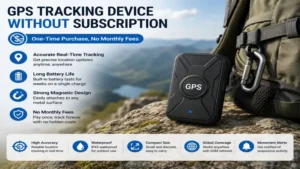
When browsing tracking hardware, it is easy to get caught up in flashy marketing phrases like “military-grade encryption” or “real-time unlimited tracking.” In reality, almost all consumer location traffic is secured using standard AES-128 or AES-256 protocols, which is more than adequate for asset safety. Instead of falling for hype, focus on the mechanical features that impact real-world longevity.
Look for high-quality neodymium magnetic housings, reinforced lanyard holes, and rubberized gaskets over the charging ports. A tracker that boasts a sleek, ultra-thin aesthetic is often brittle and prone to structural failure if exposed to under-car vibrations. Prioritize functional durability over cosmetic style every single time.
Privacy, Legality, and Compliance Guide for Asset Tracking
Before deploying any tracking system, you must familiarize yourself with local, state, and federal electronic surveillance laws. In the United States, tracking property that you legally own—such as your personal car, business equipment, or teenage child’s vehicle—is generally protected under asset protection guidelines.
Important Legal Context: Installing a hidden tracker on an asset owned entirely by another individual without their explicit written consent violates privacy statutes in many jurisdictions and can result in severe legal penalties. For detailed state-specific regulations, consult the National Conference of State Legislatures (NCSL) guidelines on electronic tracking laws.
Always ensure your corporate tracking policies are fully transparent if you are monitoring company vans or tools driven by external employees.
Frequently Asked Questions
❓ Can a subscription-free tracker work anywhere in the world?
✅ No, its performance depends entirely on its specific tracking architecture. Cellular models require matching local network bands, while Bluetooth mesh tokens need a high density of compatible smartphones nearby to pass along location updates effectively…
❓ Do no-subscription GPS devices show real-time live movement?
✅ Most do not stream smooth, continuous real-time movement updates. To preserve battery life and minimize data costs, they typically refresh their location every few minutes when motion is detected or when queried manually…
❓ What happens if a thief finds my subscription-free tracker?
✅ If a thief locates the tracking device, they can easily disable it by removing its battery or throwing it away. This makes creative, deeply hidden placement inside internal panels an absolute necessity during initial setup…
❓ Are there any hidden setup fees for these devices?
✅ True consumer mesh trackers have zero hidden setup costs. However, cellular models that use a separate SIM card will require you to purchase a prepaid balance from a telecom provider to activate network communication…
❓ Can I track my dog in the woods with a Bluetooth tag?
✅ In deep wilderness settings, a standard Bluetooth tag will fail because there are no passing smartphones to relay the signal. For deep backcountry animal tracking, a dedicated radio frequency or satellite tracker is required…
Conclusion
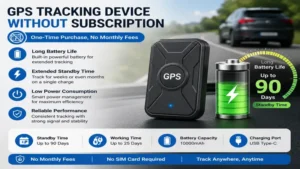
Investing in a gps tracking device without subscription is a highly effective way to protect your vehicles and assets without committing to an endless cycle of monthly bills. By matching the right network architecture—whether it’s the sweeping consumer coverage of an Apple or Samsung mesh network or the independent raw power of a prepaid cellular tracker—you gain reliable tracking capabilities on your own financial terms. Take the time to hide your hardware properly, choose an appropriate battery configuration, and enjoy the peace of mind that comes with knowing your gear is safe and your wallet is protected from recurring fees.
✨ Found this guide helpful? Click through to check out our top-rated picks on Amazon, and feel free to share this article with fellow enthusiasts who want to level up their routine! 💬🤗
Recommended for You
- 7 Secret Ways to Get Free Dog Tags for Dogs in 2026
- Dog Wire Guide: 5 Best Options for 2026 and Expert Installation Tips
- 5 Best Wire for Underground Fence Choices: Secure Your Yard in 2026
Disclaimer: This article contains affiliate links. As an Amazon Associate, I earn from qualifying purchases. If you purchase products through these links, we may earn a small commission at no additional cost to you.
✨ Found this helpful? Share it with your friends! 💬🤗