
In This Article
If you’ve searched for a diy fence for dog containment, you already know the frustration: professional installation quotes can run into the thousands, and not every yard needs a full privacy fence just to keep one dog from wandering off. The good news is that between welded wire panels, no-dig vinyl kits, wireless collars, and GPS-based virtual boundaries, there’s a real, buildable solution for almost any budget, yard shape, and dog personality in 2026.
This guide skips the generic “measure your yard first” filler and gets straight to what actually works. You’ll find seven real products worth considering, honest analysis of where each one shines (and where it doesn’t), and practical guidance on choosing between a cheap dog fence you build yourself and a no-dig or wireless system you can set up in an afternoon. According to the American Kennel Club, secure containment is one of the single biggest factors in preventing dogs from getting lost, hit by cars, or injured while unsupervised — so getting this decision right matters more than it might seem.
Whether you’re working with a quarter-acre suburban lot or a sprawling rural property, the right diy fence for dog containment comes down to matching the system to your dog’s size, digging or jumping habits, and how much labor you’re willing to put in yourself.
What Is a DIY Dog Fence?
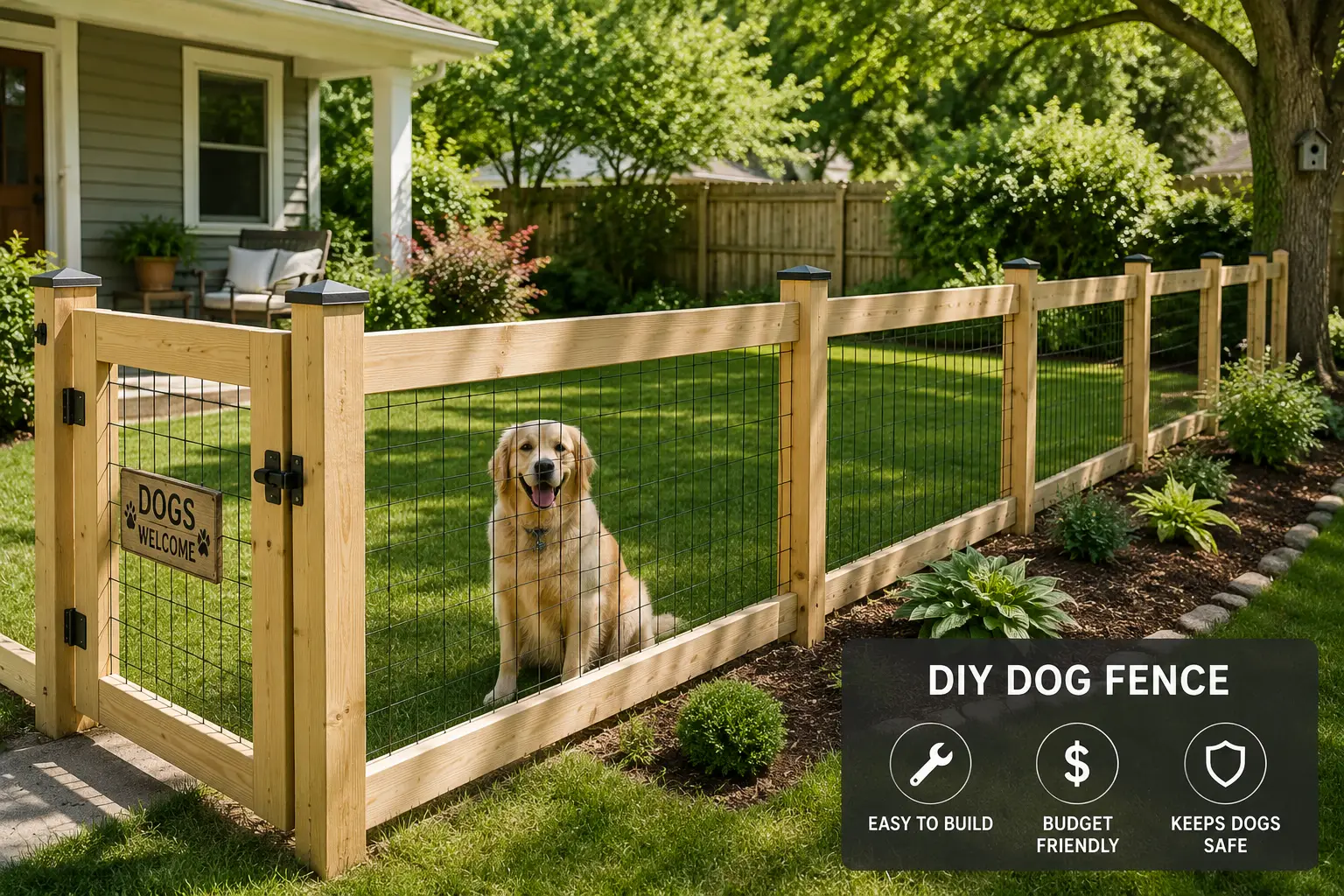
A DIY dog fence is any containment system a pet owner installs themselves rather than hiring a fencing contractor — ranging from physical barriers like welded wire and no-dig vinyl panels to electronic options like wireless, in-ground, or GPS-based virtual fences. The right choice depends on yard size, dog size, and how much digging or wiring you’re willing to do.
Homeowners typically land on a DIY dog fence for one of three reasons: cost (professional fence installation frequently runs $15–$45 per linear foot before labor), rental restrictions that rule out permanent structures, or a yard shape that a standard privacy fence simply doesn’t fit well. Physical fencing, like welded wire or vinyl panels, gives dogs a visible, unmistakable boundary and tends to work well for dogs who aren’t determined jumpers. Electronic options — wireless, in-ground, and GPS fences — skip the physical barrier entirely and instead train dogs to respect an invisible line using tone and, in most systems, a mild static correction as backup. Neither category is universally “better”; each solves a different combination of budget, yard geography, and dog temperament, which is exactly why this guide covers both.
Quick Comparison: DIY Dog Fence Options at a Glance
| Fence Type | Typical Cost | Install Effort | Best For |
|---|---|---|---|
| Welded wire / cattle panel | Under $150 | Moderate — DIY build with posts | Budget owners, large or irregular yards |
| No-dig vinyl panel kit | Around $150–$300 | Low — spikes into ground, no digging | Renters, small/medium dogs, curb appeal |
| Wireless electric fence | Around $200–$300 | Low — no digging, portable base unit | Flat, roughly circular or square yards |
| In-ground wired electric | Around $350–$500 | Moderate to high — bury wire perimeter | Irregular yards, multiple dogs |
| GPS / virtual fence | Around $150–$1,300+ | Very low — set boundaries in an app | Large, wooded, or oddly shaped properties |
Looking at the table, the split really comes down to whether you want a physical barrier your dog can see and touch or an electronic boundary that relies on training. Welded wire and no-dig vinyl solutions tend to be the cheapest entry points and require zero ongoing subscription costs, while GPS-based systems trade a higher upfront (and sometimes recurring) price for flexibility on properties where trenching or panel installation just isn’t practical. Wireless and in-ground electric fences sit in the middle, offering broader coverage than a short run of panels without the full commitment of a permanent physical structure.
One click helps other shoppers make an informed choice too! 😊
Top 7 DIY Dog Fence Options: Expert Analysis
1. YARDGARD Welded Wire Fence — cheapest true DIY build
For pure budget-conscious builders, the YARDGARD Welded Wire Fence is usually the first stop, and for good reason: a 48-inch by 100-foot roll of 14-gauge galvanized steel costs a fraction of what pre-built panels run per linear foot. The 2×4-inch mesh pattern is tight enough to stop most dogs from pushing a nose or paw through, while still being flexible enough to curve around trees, garden beds, or oddly shaped yard corners without needing custom cuts. Practically speaking, that flexibility is what separates this from rigid panel systems — you’re not locked into straight lines.
Based on comparing this to pricier vinyl-coated wire options, the trade-off is aesthetics and coating durability, not structural strength; 14-gauge steel holds up well against moderate pushing from medium and large dogs when attached to properly spaced T-posts. This is best suited for owners comfortable with basic tools who want maximum coverage per dollar and don’t mind a utilitarian look along the property line. Reviews consistently report that the wire itself performs as expected, though buyers frequently note that posts, gates, and fasteners are sold separately and add meaningfully to the total project cost.
Pros:
- ✅ Extremely low cost per linear foot of coverage
- ✅ Bends easily around curves, trees, and irregular yard shapes
- ✅ Tight 2×4-inch mesh resists nose and paw pushing
Cons:
- ❌ Posts, staples, and gate hardware are sold separately
- ❌ Uncoated galvanized finish can dull faster than vinyl-coated wire
Expect to pay in the $60–$110 range for a single roll depending on length and gauge; prices may vary, so check the current price at the time of purchase. For sheer coverage per dollar, it’s one of the strongest value picks on this list.
2. Gareinwuds Heavy-Duty Cattle Panel Fence — sturdiest budget pick for big dogs
When a standard welded wire roll feels too flimsy for a large, strong dog, the Gareinwuds Heavy-Duty Cattle Panel Fence steps up the gauge considerably. Built from 13-gauge hot-dip galvanized wire in a 3-foot by 164-foot roll, this style of fencing was originally designed to hold livestock, which means it shrugs off the kind of body-checking and jumping pressure that would eventually warp lighter mesh.
What most buyers overlook with farm-style fencing like this is just how much coverage a single roll provides — 164 feet is enough to wrap a sizable backyard with minimal seams, which matters because seams and overlaps are typically where dogs find weak points to exploit. The hot-dip galvanizing process also means this holds up to years of outdoor exposure noticeably better than lighter-gauge, spray-coated alternatives. The main consideration is height: at 3 feet, this works well for most dogs but isn’t tall enough on its own for confirmed jumpers or larger athletic breeds without adding a top rail or a taller variant.
Aggregated feedback on heavy-gauge farm fencing like this tends to highlight the stiffness of the wire as both a pro and a con — it holds its shape exceptionally well but is genuinely harder to cut and bend than lighter mesh, so factor in some extra installation time.
Pros:
- ✅ Heavy 13-gauge wire resists bending from big or strong dogs
- ✅ Hot-dip galvanized coating built for long-term outdoor exposure
- ✅ Long 164-foot roll means fewer seams and weak points
Cons:
- ❌ 3-foot height may not stop confirmed jumpers alone
- ❌ Stiffer wire takes more effort and tools to cut and shape
Pricing typically falls in the $150–$220 range per roll depending on length and gauge selected; always check the current price, since livestock-fencing costs shift with steel prices. For large or powerful breeds, the extra durability is usually worth the higher price over standard welded wire.
3. Zippity Outdoor Products Madison No-Dig Vinyl Fence Kit — no digging, done in an afternoon
For anyone who wants a finished, decorative look without touching a shovel, the Zippity Outdoor Products Madison No-Dig Vinyl Fence Kit is built specifically around that promise. Each kit includes picket-style vinyl panels roughly 30 inches tall by 56.5 inches wide that install using ground spikes — no concrete, no post holes, and no waiting days for anything to cure before your dog can use the yard again.
The vinyl construction is the real differentiator here compared to wood or metal alternatives: it won’t rot, rust, splinter, or need repainting, which translates into essentially zero annual maintenance beyond an occasional hose-down. This is best suited for renters (since it can be pulled up and taken along at move-out), owners of small to medium dogs, and anyone prioritizing curb appeal alongside containment — the white picket look reads as landscaping rather than fencing. What the spec sheet doesn’t say outright is that covering a full yard perimeter requires buying multiple kits, since each one only spans a few feet, so the per-kit price adds up quickly on larger properties.
Customer feedback on no-dig vinyl kits like this one frequently praises the fast, tool-light setup, while a recurring theme in reviews is that the roughly 30-inch height is manageable for larger or more athletic dogs to clear, making it a better match for smaller breeds or as a secondary barrier layer.
Pros:
- ✅ Installs with ground spikes — no digging or concrete needed
- ✅ Vinyl resists rot, rust, and fading for low upkeep
- ✅ Decorative picket style doubles as attractive landscaping
Cons:
- ❌ Around 30 inches tall — clearable by larger, athletic dogs
- ❌ Multiple kits needed for full-yard coverage adds up in cost
Individual kits generally run in the $50–$90 range, so budget accordingly for full perimeter coverage; prices may vary, so check current listings before ordering enough kits for your yard. It’s an excellent value pick for small dogs and partial-yard sectioning rather than full large-dog containment.
4. PetSafe Wireless Pet Containment System — no wires, no digging at all
The PetSafe Wireless Pet Containment System (also sold as the PIF-300) takes a completely different approach: instead of a physical or buried barrier, a portable base station creates a circular boundary — covering up to about half an acre — that a battery-powered collar responds to with a warning tone followed by a mild static correction if the dog continues toward the edge.
In practice, the appeal here is speed and portability. Setup typically takes under an hour, there’s no trenching, and the boundary radius is adjustable directly from the base unit, which matters for households doing initial training with a smaller, more conservative zone before expanding it. This system is best suited for dogs 8 pounds and up on relatively flat, roughly square or circular yards, since the circular boundary shape doesn’t hug property lines the way buried wire can. Reviews consistently note that consistency of correction and proper collar fit make a meaningful difference in results, which lines up with the general guidance from veterinary sources on electronic containment systems that training and supervision during the adjustment period are what determine long-term success.
Pros:
- ✅ Covers up to roughly half an acre with zero digging
- ✅ Portable base unit sets up and adjusts in under an hour
- ✅ Tone-first correction with static backup for repeat approaches
Cons:
- ❌ Circular boundary can’t follow irregular property lines precisely
- ❌ Relies on collar battery life rather than a passive barrier
Expect a price in the $200–$300 range for the base system; check the current price, as bundle configurations (extra collars, extra batteries) shift the total. For flat, open yards, this remains one of the fastest wireless dog fence setups to get running.
5. PetSafe YardMax Rechargeable In-Ground Fence — best for oddly shaped yards
Where the wireless system above falls short — irregular property lines — the PetSafe YardMax Rechargeable In-Ground Fence picks up the slack. This system uses buried (or surface-laid) boundary wire that you route yourself around the exact shape of your yard, covering roughly a third of an acre out of the box and expandable to several acres or more with additional wire.
The practical upside of a wired boundary is precision: unlike a circular wireless zone, buried wire can trace around gardens, pools, driveways, or oddly angled property lines exactly as needed. The rechargeable, waterproof collar is a meaningful upgrade over disposable-battery models too, since it removes one of the most common owner complaints with electric fencing — forgetting to replace batteries and unknowingly leaving a dog uncontained. This is best suited for households with larger, irregular yards, multiple dogs (the system supports multiple collars), or anyone who’s outgrown a wireless system’s circular limitations. The main honest trade-off is labor: laying wire around an entire perimeter, even without deep trenching, takes considerably longer than the wireless setup above.
Aggregated customer sentiment on rechargeable in-ground systems tends to be positive on reliability once trained, with the most common complaints centering on the time investment of the initial wire-laying process rather than the hardware itself.
Pros:
- ✅ Follows your yard’s exact shape, including curves and corners
- ✅ Expandable coverage for large yards or multiple dogs
- ✅ Rechargeable waterproof collar avoids constant battery swaps
Cons:
- ❌ Requires laying wire around the entire perimeter yourself
- ❌ Still depends on a functioning collar rather than a physical barrier
Pricing generally sits in the $350–$450 range for the base kit; prices may vary, so check the current price before purchase, especially if you’ll need extra wire or collars. For custom-shaped yards, it’s one of the more reliable diy fence for dog options that doesn’t require a physical structure.
6. SpotOn GPS Fence (Nova Edition) — works anywhere, zero buried wire
At the premium end of this list sits the SpotOn GPS Fence (Nova Edition), which drops the idea of wires or a base station entirely in favor of GPS-drawn virtual boundaries you create and edit from a smartphone app. Because it doesn’t rely on buried wire or a fixed base unit’s signal radius, it’s genuinely one of the only options here that works well on large, wooded, or irregular multi-acre properties where traditional wired or wireless fences struggle.
What sets this apart isn’t just the lack of installation — it’s flexibility after the fact. Need to temporarily shrink the yard for a delivery crew or expand it for a supervised outdoor day? That’s a few taps in the app rather than re-digging or repositioning a base unit. Based on comparing this to the wired and wireless options above, the honest trade-off is cost: this is by far the most expensive product on this list, and it requires an ongoing subscription for full GPS functionality, on top of the device itself. Reviews consistently flag GPS accuracy as strong in open terrain but somewhat less precise directly under dense tree cover or near large structures, which is a known limitation of consumer GPS technology generally rather than something unique to this device.
Pros:
- ✅ No wires, trenching, or base station installation required
- ✅ Virtual boundaries can be redrawn instantly from a phone app
- ✅ Handles large, wooded, or irregular properties other systems can’t
Cons:
- ❌ Premium price plus a required ongoing subscription
- ❌ GPS precision can soften under heavy tree cover or near buildings
Expect to pay roughly $1,000–$1,300 for the device plus its first membership term; always check the current price and subscription terms, since GPS-fence pricing structures change more often than hardware-only products. For sprawling or unusually shaped properties, it’s often the only realistic diy fence for dog solution that doesn’t involve a physical structure at all.
7. Fi Series 3+ Smart Dog Collar — smartest escape-alert companion
The Fi Series 3+ Smart Dog Collar isn’t a containment fence on its own — it’s better understood as the smart-monitoring layer that pairs with whatever physical or electronic boundary you choose. Built around real-time GPS tracking, it adds escape alerts the moment your dog crosses a boundary you define in the app, plus activity, sleep, and general health tracking most single-purpose fence systems don’t offer.
The practical value here shows up after the fact, not during containment itself: if your welded wire fence gets a gap dug under it, or your wireless collar’s boundary gets bumped wider by accident, this is what tells you your dog has left the zone in real time rather than you noticing an empty yard an hour later. Waterproof construction and a genuinely long battery life (rated in weeks rather than days for many users) make it low-maintenance day to day, and the LED safety light is a small but genuinely useful touch for early morning or evening yard time. This is best suited as a companion to a physical fence rather than a replacement for one — pairing a cheap dog fence build with this kind of alert layer covers the gap that a static barrier alone can’t.
Aggregated reviews consistently highlight the escape-alert feature and battery life as standout strengths, with the most common caveat being that full tracking and alert functionality requires an active membership plan rather than being fully included with the hardware purchase.
Pros:
- ✅ Real-time GPS tracking with instant escape-boundary alerts
- ✅ Adds activity, sleep, and health monitoring beyond containment
- ✅ Long battery life plus a built-in LED safety light
Cons:
- ❌ Not a physical barrier — works best alongside an actual fence
- ❌ Full feature set requires an ongoing paid membership
Collar pricing generally runs $150–$200, with membership plans priced separately; check the current price and plan terms, since bundle promotions shift often. As a safety net layered on top of any fence on this list, it closes a real gap the others can’t cover alone.
How to Build a DIY Dog Fence in a Weekend: Step-by-Step
Building a diy fence for dog containment doesn’t have to sprawl across multiple weekends if you plan the sequence correctly. Start by walking your property line and marking corners with flags or spray paint — this single step prevents the single most common first-timer mistake, which is running out of material mid-installation because the perimeter was underestimated. Add roughly 10% extra material to your estimate to cover corners, gates, and mistakes.
For physical fencing like welded wire or cattle panel, set corner and gate posts first, then run line posts every 8–10 feet, checking each for plumb before moving on — crooked posts compound into a visibly wavy fence line by the time you’re done. Unroll wire along one section at a time rather than the whole perimeter at once, stretching it taut with a fence-puller or come-along before stapling, since sagging wire is both unattractive and easier for a determined dog to push through. For no-dig vinyl kits, the process is dramatically shorter: connect panels according to the kit’s interlocking system, then drive ground spikes at a slight inward angle for extra holding power against wind and digging.
If you’re going electronic instead, the weekend priority shifts to training, not installation. Wireless and in-ground systems typically take just a few hours to physically set up, but the collar-training period — walking the boundary with your dog on leash, letting them hear the warning tone, and rewarding retreat — is what actually determines whether the system works, and most manufacturers recommend at least one to two weeks of supervised training before leaving a dog unsupervised with the system alone.
Which DIY Dog Fence Fits Your Situation? 3 Real-World Scenarios
The renter with a small dog. If you’re leasing and can’t install anything permanent, a no-dig vinyl kit like the Zippity Outdoor Products Madison No-Dig Vinyl Fence Kit is the obvious fit — it installs and removes without a trace, works well for smaller dogs under the panel height, and doubles as attractive temporary landscaping rather than looking like a workaround.
The large yard on a tight budget. For a homeowner with a sprawling, irregularly shaped half-acre and a strict budget, a combination of the YARDGARD Welded Wire Fence or Gareinwuds Heavy-Duty Cattle Panel Fence delivers the most coverage per dollar, especially if you’re comfortable with a weekend of physical labor and basic tools. This route trades convenience for cost savings that can run into the thousands compared to contractor installation.
The multi-dog household with an odd-shaped lot. If your yard has a pool, garden beds, or an oddly angled property line and you’re managing more than one dog, the PetSafe YardMax Rechargeable In-Ground Fence or the SpotOn GPS Fence (Nova Edition) make more sense than trying to force a physical fence around every obstacle. The in-ground system is the more budget-friendly of the two, while the GPS option is worth the premium if your property is large, wooded, or frequently changing shape (construction, landscaping projects, seasonal use areas).
Common DIY Dog Fence Problems (and How to Fix Them)
Problem: Your dog digs under a physical fence. This is the single most common failure point for welded wire and vinyl fencing. The fix is an L-footer — bending the bottom 12 inches of wire fencing outward and burying it flat, or laying pavers along the base of a no-dig panel kit — which stops digging dogs from ever reaching open ground at the fence line.
Problem: A wireless or GPS boundary drifts or feels inconsistent. Wireless base stations can be affected by nearby metal structures or uneven terrain, while GPS accuracy softens under dense tree cover. If you’re seeing inconsistent boundary behavior, relocate the base unit away from metal siding or large appliances, or in the case of GPS systems, redraw the boundary with a wider buffer zone in open areas.
Problem: A dog jumps a short fence or ignores an electronic correction. For jumpers, adding a single strand of wire or a top rail 12–18 inches above an existing fence line is far cheaper than replacing the whole system. For dogs who push through electronic correction (common with high-drive or thick-coated breeds), manufacturers generally recommend re-doing the training period at a stronger, properly fitted correction level rather than assuming the system has failed outright.
Problem: Gate areas become the weak point. Gates flex and gap more than fixed fence sections. Reinforce gate posts with extra bracing or concrete footing even if the rest of the fence is a no-dig or minimal-footing system, since this is disproportionately where escapes happen.
How to Choose a DIY Fence for Dog Containment
- Measure and map your yard first. Note irregular shapes, slopes, existing landscaping, and property line quirks before comparing any products — this single step eliminates most of the wrong-fit purchases people make.
- Match the fence type to your dog’s size and behavior. Diggers need buried barriers or L-footers; jumpers need height or a top rail; calm, smaller dogs may do fine with a shorter no-dig option.
- Set a realistic total budget, not just a per-item price. Physical fencing needs posts, gates, and hardware beyond the base material; electronic fences may need ongoing subscriptions or replacement collars.
- Decide how much labor you’re willing to do. Welded wire and cattle panel demand a genuine weekend project; no-dig kits and wireless systems can be functional within hours.
- Consider resale or lease restrictions. Renters and anyone anticipating a move should lean toward no-dig, portable, or fully electronic options over permanent structures.
- Check local regulations before you commit. Some municipalities regulate fence height, material, or even electronic containment systems — a quick call to your local zoning office avoids a costly redo.
- Plan for multi-dog or future-dog scenarios. If you expect to add a second dog or a larger breed later, size the system’s coverage and collar compatibility with room to grow rather than the bare minimum today.
Common Mistakes to Avoid When Buying a DIY Dog Fence
The most expensive mistake buyers make is underestimating material quantity, then paying for shipping twice or settling for a visibly patched-together fence line because they ran short mid-project. Always measure twice and buy roughly 10% more material than your exact perimeter calls for.
A close second is choosing an electronic system based purely on advertised acreage coverage without accounting for yard shape. A wireless system’s circular boundary genuinely doesn’t map onto a rectangular or L-shaped lot the way the coverage number implies, which is why so many buyers end up disappointed with usable coverage versus what the packaging suggested.
Skipping the training period is another frequent misstep with electronic fences. What most first-time buyers overlook is that these systems are behavioral tools, not instant barriers — a dog that hasn’t been walked through the boundary with proper positive reinforcement is far more likely to bolt through a correction in a moment of high excitement, like chasing a squirrel or reacting to a passing dog.
Finally, buyers frequently under-budget for gates and corners on physical fencing. These are structurally the weakest points of any DIY build, and reinforcing them properly — with sturdier posts, additional bracing, or partial concrete footing — costs more upfront but prevents the exact spots where dogs most often find an escape route.
DIY Dog Fence vs. Professional Installation
| Factor | DIY Fence | Professional Installation |
|---|---|---|
| Upfront cost | Generally lower — material only | Higher — includes labor and markup |
| Time investment | A weekend to a week of your own time | Often completed in one to two days by a crew |
| Customization | Full control over layout and materials | Limited to contractor’s available options and schedule |
| Skill required | Basic tools and patience | None — handled entirely by the crew |
| Long-term support | Self-supported; DIY repairs | Sometimes includes a labor or materials warranty |
The clearest takeaway from this comparison is that professional installation buys you time and warranty peace of mind, while a diy fence for dog project buys you cost savings and full control over material choice. For straightforward, rectangular yards with standard physical fencing needs, professional installation costs can run several times higher than the equivalent DIY materials, which is exactly why budget-conscious owners lean DIY. For highly irregular terrain, very large properties, or situations where a mistake could be costly to redo (like a shared property line), the added cost of professional installation buys real risk reduction.
Features That Actually Matter (and Ones That Don’t)
Wire gauge and mesh size matter far more than most buyers initially realize — a lower gauge number means thicker, stronger wire, and mesh openings should be small enough that your specific dog’s paws or nose genuinely can’t fit through, not just “small enough” in a generic sense. Coating type (galvanized vs. vinyl-coated) matters mainly for longevity and appearance rather than strength, so don’t overpay for coating if budget is the priority and appearance isn’t.
For electronic systems, correction consistency and collar fit matter enormously; a poorly fitted collar delivering an inconsistent tone or correction is a common, fixable cause of failed training. Background on how these boundary systems work more broadly is summarized on Wikipedia’s pet fence overview, which is a useful primer if you’re comparing wired, wireless, and GPS approaches for the first time. On the other hand, marketing claims about maximum coverage acreage matter far less than actual boundary shape flexibility for irregular yards — a smaller system that maps your real property line beats a larger-rated one that only works as a circle or rectangle.
Subscription requirements and app features are worth real scrutiny before buying a GPS-based system, since the sticker price is only part of the total cost of ownership. Meanwhile, cosmetic features like collar color or fence panel styling genuinely don’t affect containment performance at all — spend that portion of the budget on wire gauge, post spacing, or training time instead.
Long-Term Cost and Maintenance
| Budget Tier | Approx. Total First-Year Cost | What You Get |
|---|---|---|
| Under $150 | Welded wire or cattle panel roll plus basic posts | A physical barrier; ongoing cost is near zero after install |
| $150–$400 | No-dig vinyl kit or wireless electric system | Faster setup; wireless systems need occasional collar batteries |
| $400–$1,000+ | In-ground wired fence or entry GPS device | Widest, most customizable coverage; some ongoing collar upkeep |
| $1,000+ | Premium GPS fence (device plus subscription) | Maximum flexibility; recurring annual membership required |
Physical fencing has the most favorable long-term cost curve: once installed, a welded wire or vinyl fence has essentially no recurring cost beyond occasional repairs, unlike electronic systems that may require replacement collars, batteries, or ongoing subscriptions over several years of ownership. That said, electronic and GPS systems save meaningfully on labor and material costs upfront, which can offset their ongoing fees for owners who value their own time or who are working with a yard shape that would make a physical fence dramatically more expensive to install correctly.
✨ Ready to compare pricing and pick your fence type?
🔍 Take your yard containment project to the next level with this carefully researched lineup. Click a highlighted product above to check current pricing and availability, and pick the option that matches your dog’s size, your yard’s shape, and how much of a weekend you’re willing to give up. These picks are built to get you a safer backyard the whole family — dog included — will actually enjoy!
Safety, Regulations, and Standards
Before installing any containment system, it’s worth checking two separate things: local fencing ordinances and product safety recalls. Many municipalities regulate physical fence height, material, and even setback distance from property lines, and some jurisdictions have specific rules around electronic containment systems, so a quick call to your local zoning or animal control office before purchase avoids a costly redo. The CPSC’s product recall database is also worth a quick search for any product you’re considering, since it covers pet product safety notices alongside general consumer goods.
For electronic containment specifically, proper collar fit and correction-level calibration are safety issues, not just performance ones — a collar that’s too tight can cause skin irritation with prolonged wear, and manufacturers universally recommend limiting continuous daily wear time and periodically checking the contact points. If you’re introducing an electronic system to a puppy, most trainers and manufacturers recommend waiting until the dog is at least several months old and has completed basic leash training first, since electronic boundary training relies on the dog already understanding basic recall and correction concepts.
Physical fencing carries its own safety considerations too: sharp-cut wire ends should always be capped, bent inward, or covered, and any fence over a certain height in some municipalities may require a permit — details worth confirming with your specific local building department before you buy materials.
Frequently Asked Questions
❓ Is it cheaper to build a diy fence for dog containment than hiring a pro?
❓ What is the best height for a DIY dog fence?
❓ Do wireless dog fences actually keep dogs contained?
❓ How much does a DIY dog fence typically cost?
❓ Can I install a dog fence without digging?
Conclusion
There’s no single best diy fence for dog containment — only the best fit for your specific yard, budget, and dog. Owners working with a tight budget and a weekend to spare will get the most coverage per dollar from the YARDGARD Welded Wire Fence or the tougher Gareinwuds Heavy-Duty Cattle Panel Fence, while renters and small-dog households will likely prefer the fast, tool-light install of the Zippity Outdoor Products Madison No-Dig Vinyl Fence Kit.
If digging or building a physical structure isn’t in the cards, the PetSafe Wireless Pet Containment System and PetSafe YardMax Rechargeable In-Ground Fence cover flat and irregular yards respectively without a single fence panel, and the SpotOn GPS Fence (Nova Edition) remains the most flexible (if priciest) option for large or unusually shaped properties. Layering the Fi Series 3+ Smart Dog Collar on top of any physical fence adds a real-time safety net that a static barrier alone can’t provide.
Whichever direction you go, the research-backed takeaway from this guide is simple: match the system to your dog’s actual behavior — diggers, jumpers, and calm homebodies each need a genuinely different approach — rather than choosing based on price alone, and you’ll end up with a containment solution that actually holds up.
Recommended for You
- Best Dog Fence for Large Dogs: 7 Top Picks for 2026
- Dog Fence for Large Dogs: 7 Best Picks in 2026 (Ranked)
- Canine Heart Rate Monitor: 7 Best Picks for Dogs in 2026
Disclaimer: This post contains affiliate links. As an Amazon Associate, I earn from qualifying purchases made through these links, at no additional cost to you.
✨ Found this article helpful? Share it with someone who needs it! 💬🤗