
In This Article
Why a Temporary Dog Fence for Large Dogs Is Worth Getting Right
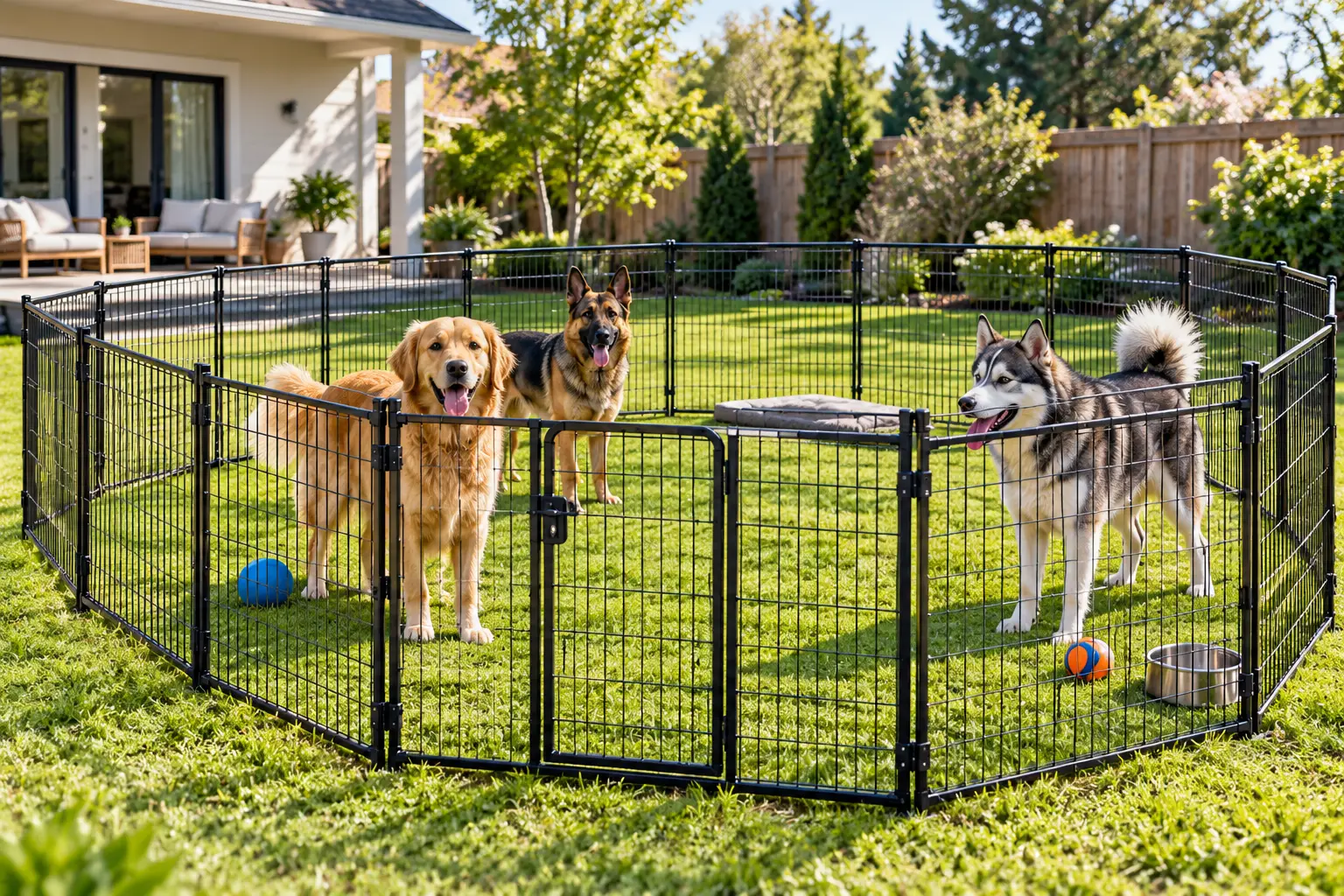
A temporary dog fence for large dogs is a portable, non-permanent barrier, such as a tall metal exercise pen, a staked plastic roll fence, or a wireless/GPS boundary system, that keeps a big dog safely contained without digging post holes, pouring concrete, or signing a contractor’s quote.
That definition sounds simple. The reality is less so. A 15-pound terrier and a 90-pound Labrador are not the same containment problem, and most “dog fence” listings are quietly written for the terrier. Big dogs lean, push, jump, dig, and, when a squirrel shows up, hit a panel at a speed that turns a cheap latch into a suggestion.
So choosing a temporary dog fence for large dogs comes down to three questions:
- ✅ How high and how rigid? Panel height and wire gauge matter more than panel count.
- ✅ How is it anchored? Ground stakes, posts, or a radio signal each fail in different ways.
- ✅ What is your situation? A rental yard, an RV site, a post-surgery recovery zone, and a weekend cabin all need different tools.
The American Kennel Club’s overview of dog fence types makes a useful point that carries over to temporary setups: the right barrier depends on how your specific dog tries to beat it, whether that is by jumping, digging, or simply walking through a weak spot.
In this guide, you’ll find seven real products available to US shoppers on amazon.com, spanning budget-friendly exercise pens, a 100-foot roll fence kit, a radio-based wireless fence, and a GPS collar. Each one gets an honest analysis built on spec sheets and aggregated owner feedback, not hype. You’ll also get setup routines, problem-and-fix guides, a cost-of-ownership breakdown, and a decision framework so you can buy once and stop worrying about the gate.
Quick Comparison: The 7 Best Temporary Dog Fence for Large Dogs Options
| Product | Type | Height / Coverage | Approx. Price Range | Best For |
|---|---|---|---|---|
| MidWest Foldable Metal Exercise Pen (48″) | Metal exercise pen | 48″ tall, ~16 sq ft (8 panels) | $80–$140 | Best all-round starter pen |
| Yaheetech 8-Panel Heavy Duty Playpen (47.5″) | Metal exercise pen | ~47.5″ tall, 8 panels | $110–$150 | Tall walls on a budget |
| FXW Rollick Unleashed Dog Playpen (40″/45″) | Rod-connected pen | 40″ or 45″ tall, 8–48 panels | $60–$420 (by panel count) | RV trips and fast setup |
| PawHut Heavy-Duty Dog Playpen (47″) | Metal exercise pen | 47″ tall, wide 31.5″ panels | $100–$150 | Larger footprint per panel |
| Tenax Pet Fence DIY Kit (4′ x 100′) | Staked plastic roll fence | 4 ft tall, 100 ft long | $150–$200 (kit) | Fencing a whole yard section |
| PetSafe Stay & Play Wireless Fence for Stubborn Dogs | Radio wireless fence | Circular, up to 3/4 acre | $300–$390 | Renters with open yards |
| Halo Collar 5 | GPS virtual fence | Custom shapes, anywhere with GPS | $450–$600 + subscription | Travel, cabins, big properties |
Looking at the table above, the three tall metal pens (MidWest Foldable Metal Exercise Pen, Yaheetech 8-Panel Heavy Duty Playpen, and PawHut Heavy-Duty Dog Playpen) solve the “small, secure zone” problem for under about $150, while the Tenax Pet Fence DIY Kit is the budget way to enclose real running room. The PetSafe Stay & Play Wireless Fence for Stubborn Dogs and the Halo Collar 5 trade a physical wall for training-dependent boundaries, which is why they cost more and demand more of you up front.
💬 One click helps other shoppers make an informed choice too! 😊
Top 7 Temporary Dog Fence for Large Dogs Picks: Expert Analysis
Every pick below was chosen for one reason: it is realistically usable with a large dog. Prices are shown as ranges because Amazon prices change constantly, so always check the current price before buying.
1. MidWest Foldable Metal Exercise Pen (48″) — best all-round starter pen
The MidWest Foldable Metal Exercise Pen is the “nobody got fired for buying it” option: a proven design from a long-running US pet brand, in the tallest standard height the line offers.
The 48-inch version uses eight 24-inch-wide panels that form roughly 16 square feet of space, with ground stakes for outdoor use and a step-through door on the door model. In practice, 48 inches is the height where most large dogs that aren’t committed jumpers stop treating the wall as a challenge. The full pen weighs around 32 pounds, which means it is heavy enough to resist casual leaning but still light enough for one person to fold and toss in an SUV.
Based on comparing the specs, this is the pen for calm-to-moderate large dogs: a senior Golden Retriever, a Lab recovering from a spay, or a young Shepherd who needs a time-out zone on the patio. It is not a solution for an athletic escape artist who has already learned to climb. Retail reviews consistently praise its sturdiness and simple fold-flat design, while a recurring complaint is that the standard 16 sq ft footprint feels cramped for big breeds unless you link two pens.
Pros:
- ✅ Tallest standard height in its class at 48 inches
- ✅ Folds flat and sets up without tools
- ✅ Backed by a one-year manufacturer’s warranty
Cons:
- ❌ Default footprint is tight for a 90-pound dog
- ❌ Clips between panels can loosen under heavy leaning
💲 Expect roughly $80–$140 depending on finish and door option, which is solid value for a pen most owners keep for years.
2. Yaheetech 8-Panel Heavy Duty Playpen (47.5″) — tall walls on a budget
The Yaheetech 8-Panel Heavy Duty Playpen gives you near-48-inch walls at a price that often undercuts name-brand pens.
Its panels connect with long metal rods that double as ground anchors, so the same piece that joins two panels also pins them into soil. That matters because the weakest point of any pen is the joint, not the wire. The rod design also lets you build an octagon, square, or rectangle simply by adding or removing panels, and Yaheetech sells compatible heights from 24 to roughly 47.5 inches.
What most buyers overlook is that “heavy duty” here describes the frame, not the connectors. Reviews are genuinely split: many owners describe the panels as sturdy and easy to manage alone, while a vocal minority report that the thin connector rods bend under pressure and make reassembly frustrating. Here’s what to weigh: if your dog leans but doesn’t charge, this pen is excellent value. If your dog slams into walls, budget for heavier stakes or zip ties at every joint.
Pros:
- ✅ Near-48-inch height for well under premium pricing
- ✅ Connector rods double as ground anchors
- ✅ Flexible layouts by adding or removing panels
Cons:
- ❌ Thin connector rods can bend under hard impacts
- ❌ Reassembly gets fiddly once a rod is warped
💲 Usually priced in the $110–$150 range, it’s one of the best height-per-dollar deals for owners of non-destructive large dogs.
3. FXW Rollick Unleashed Dog Playpen (40″/45″) — fastest setup for RV trips
The FXW Rollick Unleashed Dog Playpen wins on convenience, and for campers and travelers, convenience is the whole point.
FXW’s patented rod-connected system means panels slide together without separate clips, and owners routinely describe setup in roughly five minutes. The line comes in 40- and 45-inch heights, with configurations ranging from 8 panels to 48 panels, so you can build anything from a small potty zone to a sprawling campsite run. Rounded ball tops on the posts are a thoughtful detail, since a big dog pawing the top edge won’t catch a sharp cut wire.
On paper, the 40-inch height is the floor for large dogs, not the ceiling. Several independent roundups note it holds up well for dogs up to roughly 70 pounds, so for a tall, leggy breed, the 45-inch version is the smarter buy. Aggregated feedback is strongly positive on assembly speed, portability, and rust resistance, with the main caveat being that larger panel counts get expensive quickly.
Pros:
- ✅ Tool-free rod connections set up in minutes
- ✅ Huge range of panel counts and heights
- ✅ Rounded post tops protect paws and noses
Cons:
- ❌ 40-inch version is marginal for jumpers over 70 pounds
- ❌ Big configurations climb steeply in price
💲 Prices range from about $60 for small kits to over $400 for 24+ panels, so price out the exact footprint you need before deciding it’s the value pick.
4. PawHut Heavy-Duty Dog Playpen (47″) — most floor space per panel
The PawHut Heavy-Duty Dog Playpen stands out because each panel is wide, not just tall.
With eight panels at roughly 31.5 inches wide and 47 inches high, an octagon from this pen encloses noticeably more ground than the same number of 24-inch panels. For a large dog, that extra width translates into room to turn around, stretch out, and walk a few steps instead of pacing in a tight circle. The included door is a full walk-in style, which is easier for you to enter with a water bowl than a low step-through.
Here’s the honest picture: PawHut (an Aosom brand) has far fewer aggregated reviews for this specific model than MidWest or FXW, so long-term durability data is thinner. What the spec sheet does tell you is useful. Wider panels mean fewer joints per foot of fence, and fewer joints mean fewer weak points. That makes it a smart pick for owners who want space without buying a second pen.
Pros:
- ✅ Wide 31.5-inch panels create a roomier enclosure
- ✅ Walk-in door makes cleaning and feeding easier
- ✅ Fewer joints per foot than narrow-panel pens
Cons:
- ❌ Limited long-term review data for this exact model
- ❌ Bulky panels are harder to store in small cars
💲 Typically in the $100–$150 range, it offers strong space-per-dollar value if verified reviews look good when you check the listing.
5. Tenax Pet Fence DIY Kit (4′ x 100′) — best for fencing real yard space
The Tenax Pet Fence DIY Kit is what you buy when a pen is too small and a permanent fence is too permanent.
The kit pairs a 4-foot by 100-foot roll of UV-treated polypropylene mesh with 10 adjustable poles that extend up to 8 feet, plus self-locking ties and sod staples. The mesh has a certified breaking load of roughly 600–650 pounds, which sounds like overkill until you picture a 100-pound dog hitting it at full sprint. Because it’s plastic, it won’t rust or rot, and it’s made in the USA.
What the spec sheet doesn’t say, but owner Q&As reveal: plastic mesh is no match for a dedicated chewer, and Tenax itself acknowledges that animals prone to chewing may breach it. It also looks best, and holds tension best, when you add sturdier T-posts at corners. Best fit? A rental backyard, a vacation property, or a section of acreage for a large dog that respects boundaries but needs room to run.
Pros:
- ✅ Encloses up to 100 linear feet for a modest price
- ✅ Rust-proof, UV-treated mesh lasts multiple seasons
- ✅ Sod staples help block shallow digging along the base
Cons:
- ❌ Determined chewers can bite through polypropylene mesh
- ❌ Sags without extra corner bracing on long runs
💲 The full kit usually lands around $150–$200 (the roll alone is often under $100), making it the cheapest way to enclose a large area by far.
6. PetSafe Stay & Play Wireless Fence for Stubborn Dogs — best no-dig option for renters
The PetSafe Stay & Play Wireless Fence for Stubborn Dogs creates an invisible circular boundary with zero digging, wires, or posts.
An indoor transmitter broadcasts a radius you can adjust up to about 3/4 acre, and a rechargeable, waterproof receiver collar delivers a warning tone followed by one of five levels of static correction if your dog keeps going. The system supports an unlimited number of dogs, provided you buy extra collars. For renters, the big win is portability: unplug the transmitter, and your “fence” moves with you.
Based on comparing the specs, this system’s limits are geometric and behavioral. The boundary is always a circle centered on the transmitter, so oddly shaped lots waste coverage. And it only works with real training, typically a couple of weeks of flag-based sessions. Independent hands-on reviews found it safe and effective once training was done, while noting the transmitter is bulky with limited placement options. Also weigh the welfare question covered later in this guide before choosing any static-correction product.
Pros:
- ✅ No digging, wiring, or posts required
- ✅ Moves easily between rentals or vacation homes
- ✅ Tone-only mode plus five adjustable correction levels
Cons:
- ❌ Circular boundary only, so irregular yards waste space
- ❌ Requires disciplined training and a static-correction collar
💲 Usually $300–$390, it’s fair value against a professionally installed fence, provided you commit to the training.
7. Halo Collar 5 — most flexible for travel and big properties
The Halo Collar 5 is a GPS virtual fence: you draw boundaries in an app, and the collar does the rest, wherever you are.
Launched in September 2025, it uses dual-frequency GPS with the company’s “Precision+” correction, which Halo claims delivers sub-2-foot accuracy, plus rapid location updates and roughly 48 hours of battery life per manufacturer specs. You can save unlimited fence shapes, so the backyard, a lake cabin, and a campsite can each have their own perimeter. It also offers real-time tracking, which no physical pen can match.
The tradeoff is ongoing cost: a Halo subscription is required to activate GPS fencing and tracking, with plans starting around $10 a month at the time of writing. Independent reviews, including a 2026 hands-on review from Outdoor Life, praise its versatility while flagging the high price and subscription. For a large dog on a big rural property, a frequent traveler, or a family that rents different cabins, the math can still beat a permanent fence. Remember, though, that accuracy claims come from the manufacturer, and GPS performance drops near tall buildings and dense tree cover.
Pros:
- ✅ Unlimited custom-shaped fences anywhere with GPS
- ✅ Built-in real-time tracking if your dog gets out
- ✅ No transmitter, posts, or wires to install
Cons:
- ❌ Mandatory subscription adds a recurring cost
- ❌ Highest upfront price in this lineup
💲 Expect around $450–$600 for the collar plus the monthly plan, so it’s worth it mainly if you’ll use its portability and tracking often.
✨ Don’t miss these exclusive deals!
🔍 Take your large dog’s outdoor time to the next level with this carefully curated lineup. Click a highlighted item to check current pricing and availability. These picks will help you get safe, stress-free freedom the whole family will enjoy!
How to Set Up a Portable Dog Fence for Large Dogs: Your First 30 Days
Buying the right fence is half the job. The other half is installing and introducing it so your dog never learns that the wall can be beaten.
🛠️ Day 1: Install it like you expect a test
- ✅ Pens: drive every ground stake fully, then zip-tie each panel joint top and bottom. Two ties per joint cost pennies and remove the most common failure point.
- ✅ Roll fences: set T-posts or the kit poles every 8–10 feet, pull the mesh tight, and pin the bottom edge with sod staples every couple of feet.
- ✅ Wireless/GPS: charge collars fully, set the boundary well inside hazards like roads, and place training flags at the edge so your dog has a visual cue.
🐾 Days 2–7: Make it boring, then make it good
Walk your dog around the inside on a leash. Reward calm sniffing and loose-leash walking near the barrier. For pens, feed meals inside so the space means good things. For wireless and GPS systems, follow the manufacturer’s flag training in short sessions, two or three times a day.
🔍 Days 8–21: Supervised freedom
Drop the leash but stay present. Watch for three warning signs: pawing at a joint, testing one corner repeatedly, or digging along the base. Each tells you exactly where to reinforce.
✅ Days 22–30: Build a maintenance habit
- ✅ Re-tighten zip ties and re-seat stakes weekly, especially after rain softens the soil.
- ✅ Check collar fit and contact points every few days for skin irritation.
- ✅ Inspect mesh for chew marks and sagging after storms.
The biggest first-month mistake? Leaving a big dog unsupervised too early. One successful escape teaches more than ten good days.
Real-World Scenarios: Matching Large Dogs to the Right Temporary Fence
Specs only mean something when they meet a real situation. Here are three common profiles and the reasoning behind each match.
🏠 Scenario 1: The renter with an open backyard
Dog: 80-pound Lab mix, friendly, not a jumper. Budget: about $200. Use: daily, several hours.
A landlord won’t allow posts set in concrete, and the yard is roughly a quarter-acre. The Tenax Pet Fence DIY Kit is the natural fit: 100 feet of 4-foot mesh can close off a rear section without any permanent holes, and it comes down at move-out. If the dog has any history of chewing, pair it with a supervision schedule rather than long solo stints.
🚐 Scenario 2: The weekend RV couple
Dog: 65-pound Australian Shepherd, energetic. Budget: $150–$250. Use: two to three weekends a month.
Setup speed beats everything else here, which points to the FXW Rollick Unleashed Dog Playpen in the 45-inch height. It assembles in minutes at the campsite, folds flat in the RV basement, and its height respects an athletic herding breed.
🌲 Scenario 3: The rural family with a roaming hound
Dog: 90-pound Coonhound with a nose that ignores fences. Budget: flexible. Use: daily, large property.
A physical fence around several acres is expensive, and pens are too small. The Halo Collar 5 lets the family draw a boundary around the usable land and track the dog if it ever gets out. The ongoing subscription is real, but so is the cost of a lost hound on a county road.
Problem → Solution: Fixing the Most Common Large-Dog Escapes
Large dogs tend to escape in predictable ways. Here are the five most common, with targeted fixes.
❌ Problem 1: Your dog leans until the pen walks
Solution: A pen that “walks” across the lawn isn’t anchored. Drive every stake, then add extra stakes or tent pegs at the corners. Upgrading from the Yaheetech 8-Panel Heavy Duty Playpen‘s standard rods to heavier stakes is a common, cheap fix.
❌ Problem 2: Your dog digs under the bottom edge
Solution: Pin the base. Sod staples (included with the Tenax Pet Fence DIY Kit) or a strip of buried hardware cloth along the inside edge stop most shallow diggers. Giving your dog a legal dig pit elsewhere helps even more.
❌ Problem 3: Your dog jumps or climbs out
Solution: Height is the only true cure for a jumper. Move from a 40-inch pen to a 47–48-inch model like the MidWest Foldable Metal Exercise Pen or the PawHut Heavy-Duty Dog Playpen, and remove anything nearby that works as a launch pad, like coolers or chairs.
❌ Problem 4: Your dog blows through a wireless boundary
Solution: This usually means the dog was never fully trained, or the reward on the other side (a deer, a jogger) outweighs the cue. Go back to flag training, and never rely on a wireless or GPS system as the only barrier near a busy road.
❌ Problem 5: Panels pop apart at the joints
Solution: Zip ties, twice per joint. It’s unglamorous, and it works.
How to Choose a Temporary Dog Fence for Large Dogs
Use these seven steps to narrow the field in minutes.
- Measure your dog standing on hind legs. Your fence should be meaningfully taller than that reach; for most large breeds, 45–48 inches is the practical minimum for pens.
- Identify the escape style. Jumpers need height, diggers need a pinned base, chewers need metal, and wanderers may suit a virtual boundary.
- Decide on space versus security. Pens give maximum security in a small zone; roll fences and wireless systems give space with less physical certainty.
- Check the anchoring method. Look for long ground stakes, rod-anchors, or post compatibility. Freestanding pens without anchors are indoor products.
- Match portability to your life. Travelers should prioritize folding weight and setup time; homeowners can accept bulkier systems.
- Calculate total cost, not sticker price. Subscriptions, extra collars, and extra panels change the math (see the cost section below).
- Confirm the rules. Read your lease, HOA covenants, and local ordinances before installing anything visible or electronic.
Heavy Duty Dog Playpen vs Wireless and GPS Fences: Which Wins?
This is the real decision most large-dog owners face, and it is not just a spec comparison. It’s a philosophy question: do you want a wall, or do you want a rule?
A heavy duty dog playpen is a wall. It works on day one, it works when the battery dies, and it works on dogs who haven’t been trained. Its weakness is size: even a large pen rarely encloses more than a few hundred square feet without becoming expensive and unwieldy.
Wireless and GPS systems are rules. They can cover an acre or more, they’re invisible, and they move with you. But they only work if the dog has learned the rule and cares about it more than whatever is on the other side. They also depend on static correction or other collar cues, which raises welfare questions. The American Veterinary Society of Animal Behavior has published a position statement recommending reward-based training methods and cautioning against aversive tools such as shock collars, which is worth reading before you pick a static-correction system.
| Factor | Metal Pens & Roll Fences | Radio Wireless Fence | GPS Virtual Fence | Permanent Wood/Chain-Link |
|---|---|---|---|---|
| Works without training | Yes | No | No | Yes |
| Coverage | Small to medium | Up to ~3/4 acre (circle) | Large, any shape | Any |
| Portability | High | High | Highest | None |
| Upfront cost | Low | Moderate | High | Very high |
| Best for | MidWest Foldable Metal Exercise Pen, Tenax Pet Fence DIY Kit | PetSafe Stay & Play Wireless Fence for Stubborn Dogs | Halo Collar 5 | Long-term homeowners |
The table shows why most owners end up combining tools: a physical pen for unsupervised time and a virtual boundary for supervised roaming. Permanent fencing still wins on reliability, but its cost and immobility are exactly why temporary options exist in the first place.
Features That Actually Matter (and Ones That Don’t)
Marketing copy loves the word “heavy duty.” Here’s how to see through it.
✅ Features that matter
- Height of 45 inches or more for pens holding large dogs. Below that, you’re relying on your dog’s good manners.
- Joint design. Long, thick rods or locking clips beat thin pins every time, because joints fail before wire does.
- Ground anchoring. Stakes that go several inches into soil turn a pen into a fence.
- Door style. A walk-in door with a two-point latch is easier for you and harder for a clever nose to nudge open.
- For wireless/GPS: tone-only or vibration modes, battery life, and how the system handles re-entry if your dog does cross.
❌ Features that matter less than you think
- Panel count on its own. Sixteen short panels don’t stop a jumper; eight tall ones might.
- Color options. Nice for aesthetics, irrelevant to containment.
- “Indestructible” claims. No temporary fence is chew-proof against a determined large dog; plan for supervision instead.
- Huge advertised coverage. A 3/4-acre radius is meaningless if your yard is long and narrow.
What most buyers overlook is the interaction between features. A 48-inch pen with weak joints can be less secure than a 45-inch pen with rigid rod connections. Evaluate the whole system, not the headline number.
Long-Term Cost and Maintenance of a Temporary Dog Fence for Large Dogs
Sticker price tells you what you pay today. Total cost of ownership tells you what you really pay.
| Product | Approx. Upfront | Recurring Costs | Typical Maintenance | Long-Term Value |
|---|---|---|---|---|
| MidWest Foldable Metal Exercise Pen | $80–$140 | None | Zip ties, stake checks | Excellent |
| FXW Rollick Unleashed Dog Playpen | $60–$420 | Optional extra panels | Rod inspection | Very good |
| Tenax Pet Fence DIY Kit | $150–$200 | Occasional replacement mesh | Re-tensioning, chew checks | Excellent per foot |
| PetSafe Stay & Play Wireless Fence for Stubborn Dogs | $300–$390 | Extra collars for extra dogs | Charging, contact checks | Good |
| Halo Collar 5 | $450–$600 | Monthly subscription | Charging every couple of days | Depends on usage |
Over three years, the metal pens and the Tenax Pet Fence DIY Kit cost almost nothing beyond the purchase price. The Halo Collar 5 is the opposite: a subscription starting around $10 a month adds several hundred dollars over the same period, which only makes sense if you use the tracking and multi-location fencing. The PetSafe Stay & Play Wireless Fence for Stubborn Dogs sits in the middle, with no subscription but real costs per additional dog.
Maintenance is also a hidden cost in time. Metal pens need a five-minute weekly check. Roll fences need re-tensioning after storms. Electronic systems need disciplined charging; a dead collar is no fence at all. Pick the maintenance routine you will actually keep.
Safety, Regulations, and Standards for Temporary Dog Fencing
Temporary doesn’t mean unregulated. Before you install, check these four areas.
📜 Leases and HOA rules
Many leases prohibit digging or altering the yard, and many HOAs restrict visible fencing, even temporary mesh. Pens and wireless systems usually avoid both issues, but get written permission if in doubt.
🏛️ Local ordinances
Cities and counties often have leash and “at large” laws that hold owners responsible if a dog leaves the property. A temporary fence doesn’t change your liability if it fails, which is another argument for supervision during the first weeks.
📡 Electronic devices
Wireless transmitters and GPS collars sold in the US must meet FCC requirements for radio-frequency devices, so stick to established brands with clear compliance labeling rather than unbranded imports. Also, a static-correction collar should never be left on around the clock; follow the manufacturer’s wear-time guidance to prevent skin irritation.
🐕 Physical safety
- ✅ Check pens for sharp wire ends and pinch points at joints.
- ✅ Never use a pen or roll fence as a tie-out anchor, since a tethered dog can tangle.
- ✅ Provide shade and water inside any enclosure; large dogs overheat quickly in summer.
- ✅ Never use any temporary fence as the only barrier next to a busy road.
Common Mistakes to Avoid When Buying a Temporary Dog Fence for Large Dogs
Even careful shoppers trip over these. Spotting them now saves you a return, or a frantic neighborhood search.
- Buying for your dog’s size today, not adulthood. A 6-month-old Great Dane puppy fits a 36-inch pen this week. In four months, it won’t.
- Trusting “for large dogs” in the title. Listings use the phrase loosely. Check the real height and joint design instead.
- Skipping the anchors. Owners often set pens on grass without stakes, then wonder why the dog “escaped.” The pen simply moved.
- Expecting electronics to replace training. The PetSafe Stay & Play Wireless Fence for Stubborn Dogs and the Halo Collar 5 are training systems first and fences second.
- Ignoring footprint. A big dog in a tiny pen gets bored, and bored dogs test walls. Link two pens or choose wider panels like the PawHut Heavy-Duty Dog Playpen.
- Forgetting about chewing. Plastic mesh and soft-sided pens are a poor match for dogs with a chewing history.
- Leaving a big dog alone on day one. Supervise until you’ve seen how your dog behaves at the boundary.
The AKC’s guide to keeping a dog from escaping the yard adds a smart extra layer worth borrowing: a double-gate “airlock” entry, which stops a large dog from bolting the moment you open the pen door.
FAQ: Temporary Dog Fence for Large Dogs
❓ What is the cheapest temporary dog fence for large dogs that actually works?
❓ Can a portable dog fence for large dogs stay up permanently?
❓ How tall should a temporary outdoor dog fence be for a German Shepherd?
❓ Do no-dig dog fences work for 100-pound dogs?
❓ Is a GPS dog fence worth it over a heavy duty dog playpen?
Conclusion: Choosing the Right Temporary Dog Fence for Large Dogs
The best temporary dog fence for large dogs isn’t the one with the biggest “heavy duty” claim. It’s the one that matches your dog’s escape style, your space, and the routine you’ll actually maintain.
If you need a secure, no-fuss zone, start with the MidWest Foldable Metal Exercise Pen or stretch your budget further with the Yaheetech 8-Panel Heavy Duty Playpen. Travelers and RVers will love the speed of the FXW Rollick Unleashed Dog Playpen, while owners who want more room per panel should look at the PawHut Heavy-Duty Dog Playpen. To enclose real running space cheaply, the Tenax Pet Fence DIY Kit is hard to beat. And if you need boundaries without physical walls, the PetSafe Stay & Play Wireless Fence for Stubborn Dogs suits renters with open yards, while the Halo Collar 5 is the most flexible option for big properties and frequent travelers.
Whichever you choose, remember the three habits that matter more than any product: anchor it properly, introduce it with patience and rewards, and supervise until you trust it. Do that, and your big dog gets something every large breed deserves: room to move, without the risk of a runaway afternoon.
🐕 Give your big dog safe freedom today!
🛒 Ready to build a safer space? Click any highlighted product above to check current pricing and availability, and find the fence that fits your dog, your yard, and your lifestyle!
Recommended for You
- Types of Trackers: 7 Best Picks Compared for Smart Buyers (2026)
- Pet Chip Network 2026: 7 Proven Tools to Bring Lost Pets Home
- Light Up Cat Collar: 7 Brilliant, Breakaway-Smart Picks for 2026
Disclaimer: This post contains affiliate links. As an Amazon Associate, I earn from qualifying purchases made through these links, at no additional cost to you.
✨ Found this article helpful? Share it with someone who needs it! 💬🤗