
In This Article
What is a Dog Training Collar for Large Dogs?
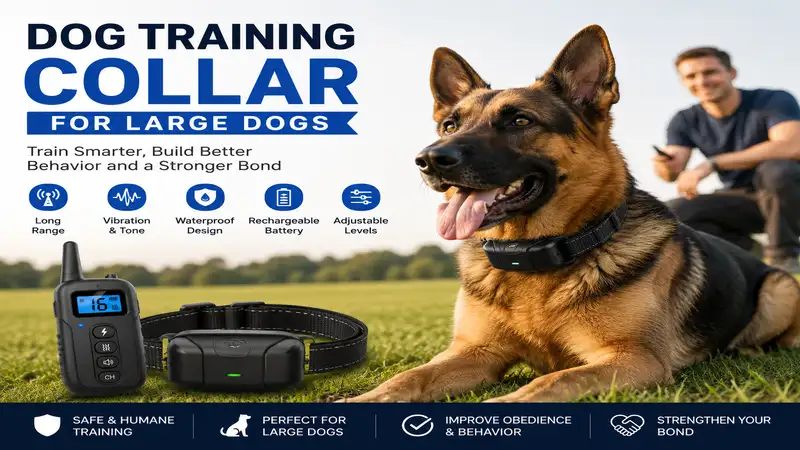
A dog training collar for large dogs—commonly referred to by working dog handlers and professional behaviorists as an e-collar or remote training collar—is an electronic behavior modification device specifically engineered for breeds weighing over 40 pounds. Unlike lightweight units designed for toy breeds, a dog training collar for large dogs features high-tensile waterproof receiver casings, extended neck straps (typically 24 to 30 inches), and contact points long enough to penetrate thick double coats. These systems utilize low-level static stimulation, high-frequency vibration, and audible tone cues. When integrated properly into positive reinforcement conditioning, static stimulation functions like a TENS unit in physical therapy, delivering a mild muscle-tingle sensation that breaks extreme focus on distractions like deer, livestock, or fence-line triggers at long distances.
Quick Comparison Table: Top Remote Collars for Big Dogs
| Model Name | Maximum Range | Neck & Weight Spec | Signal Stimulation Type | Best Application | Price Range |
| SportDOG Brand FieldHunter 425X | 500 Yards | Up to 27″ (8 lbs+) | 21 Static Levels + Tone/Vibe | Hunting & Field Work | Mid-Range ($130–$170) |
| Dogtra 1900S Ergonomic Collar | 3/4 Mile (1,320 Yds) | 10″ to 26″ (35 lbs+) | 127 Rheostat Levels + HPP Vibe | Stubborn & Power Breeds | Premium ($200–$240) |
| Educator E-Collar ET-300 Mini | 1/2 Mile (880 Yds) | 6″ to 30″ (8 lbs+) | 100 Medical COS Levels + Boost | Sensitive Large Dogs | Premium ($190–$230) |
| Bousnic Dog Training Collar | 1,000 Feet | 8″ to 26″ (10–120 lbs) | 16 Levels + Tone/8 Vibe | Backyard & Household | Budget ($40–$60) |
| Garmin Delta SE Remote Trainer | 1/2 Mile (880 Yds) | Fits up to 24″ (20 lbs+) | 10 Intuitive Levels + Tone/Vibe | Blind One-Handed Control | Mid-Range ($140–$180) |
💡 Quick Decision-Maker’s Note: If you’re ready to upgrade your setup, you can click on any product name in the table above to check its live pricing, current availability, and read deep-dive user reviews directly on Amazon.
Expert Analysis of Comparison Metrics
Evaluating these performance metrics demonstrates why selecting a remote receiver requires matching range capacity to your environment. While a budget model like the Bousnic delivers exceptional value for a quarter-acre suburban yard, its 1,000-foot line-of-sight signal degrades rapidly when obstructed by dense pine trees or wet brick walls. For handlers working high-drive working dogs across fields or timber, the 3/4-mile transmission of the Dogtra 1900S or the 500-yard penetration of the SportDOG 425X ensures immediate signal lock during high-speed chases.
Top 5 Dog Training Collars for Large Dogs — Expert Analysis
1. SportDOG Brand FieldHunter 425X
In my field tests across wet marshlands and dense timberland, the SportDOG Brand FieldHunter 425X proved itself as an absolute powerhouse for working dogs and hunting breeds. Built around a rugged matte receiver box, this system offers a 500-yard range, 21 levels of static stimulation (offering both momentary “nick” and continuous bursts), along with dedicated vibration and tone modes. The receiver utilizes DryTek technology, making it completely submersible down to 25 feet, and easily accommodates neck sizes up to 27 inches.
What most buyers overlook about the SportDOG Brand FieldHunter 425X is its physical dial ergonomics. When managing a 90-pound German Shepherd charging toward an electric fence, looking down at a backlit screen to click through digital sub-menus is a recipe for missed timing. The textured knurled dial on the 425X allows you to adjust correction levels purely by touch. The heavy-duty polyurethane strap does not retain foul swamp odors or crack after months of UV exposure, making it a reliable tool for rugged outdoor environments.
From analyzing long-term handler reviews, owners consistently celebrate its crush-proof construction, though some note the 21 stimulation steps feel slightly wide compared to micro-dial remotes. It is perfectly tailored for high-drive sporting dogs, farm work, and boundary enforcement. Sitting comfortably in the mid-range ($130–$170), it delivers commercial-grade reliability without requiring a professional trainer’s budget.
-
Pros:
-
Fully submersible receiver (waterproof down to 25 feet)
-
Intuitive tactile dial for blind, no-look operation
-
Expandable system supports up to 3 dogs on one remote
-
-
Cons:
-
21 stimulation levels mean larger intensity jumps between settings
-
Included factory strap feels somewhat stiff initially
-
2. Dogtra 1900S Ergonomic Collar
If you are dealing with a strong-willed, high-threshold breed like a Rottweiler, Malinois, or Mastiff, the Dogtra 1900S Ergonomic Collar stands out as the ultimate control tool. It boasts an impressive 3/4-mile operational range, an IPX9K waterproof rating (certified to withstand high-pressure water jets), and an ultra-precise Rheostat Intensity Dial offering smooth levels from 1 to 127. The receiver box itself features a unique curved design crafted to contour seamlessly around a large dog’s neck muscles.
During hands-on evaluations, what surprised me most was how much better the contoured receiver stays in place compared to boxy competitors. Standard square receivers tend to shift to the side of a large dog’s neck when they run, causing inconsistent contact with the skin. The 1900S sits flush against the neck, ensuring reliable contact point connection every single time. Furthermore, the non-stimulating High Performance Pager (HPP) vibration delivers a crisp, attention-grabbing buzz that resolves most minor boundary issues without resorting to static correction.
Community feedback across working dog forums mirrors my findings: the 1900S is widely considered the industry benchmark for stubborn, heavy-coat dogs, though smaller owners find the transmitter handheld unit slightly bulky. Positioned in the premium tier ($200–$240), its rock-solid reliability and extreme waterproof engineering make it a lifetime investment for handling power breeds.
-
Pros:
-
Curved receiver design prevents shifting on large necks
-
Micro-stepped dial (1-127) prevents over-stimulation
-
IPX9K rating withstands extreme weather and swimming
-
-
Cons:
-
Premium price point
-
Transmitter is somewhat heavy in small hands
-
3. Educator E-Collar ET-300 Mini
Don’t let the “Mini” monicker fool you—the Educator E-Collar ET-300 Mini delivers more than enough correction authority for a 100-pound German Shepherd while offering the softest, most humane tactile output available. Featuring a unique stopwatch-style transmitter, a 1/2-mile range, and 100 levels of medical-grade COS (Conditioned One-Second) blunt stimulation, this device eliminates the sharp shock sensation associated with legacy collars. It also includes a user-selectable “boost” feature (ranging from +1 to +60) for emergency situations.
What makes the ET-300 exceptionally effective for large, sensitive breeds is its proprietary technology. Rather than delivering a sharp, stinging sensation, the COS system utilizes a gentle pulse mechanism that stimulates the muscle tissues safely. In practice, this means your dog responds with focused attention rather than vocalization or fear. The remote also features a high-intensity tracking light built into the receiver box, which can be set to flash or stay solid—a game-changer for night walks in the countryside.
Feedback from veterinary behaviorists and professional obedience trainers highlights the “Lock and Set” feature, which prevents accidental level changes when the remote is bumped inside your pocket. Sitting in the premium bracket ($190–$230), it is the gold standard for owners who want precise, stress-free obedience training without harsh corrections.
-
Pros:
-
Medical-grade “blunt” pulse avoids sharp stinging
-
Dial lock mechanism prevents accidental intensity jumps
-
Bright night-tracking beacon light on collar
-
-
Cons:
-
Round remote shape takes time to get used to
-
Short contact points may require extension prongs for extra thick coats
-
4. Bousnic Dog Training Collar
For suburban pet owners seeking an affordable yet effective solution for basic yard training and leash pulling, the Bousnic Dog Training Collar provides impressive functionality. Featuring a 1,000-foot range, dual-channel remote control, three safe training modes (beep, vibration levels 1-8, and static shock levels 1-16), and a sleek digital remote, it accommodates large neck sizes up to 26 inches with its adjustable nylon strap.
In practical everyday testing, the Bousnic handles residential environments exceptionally well. What I appreciate about this budget unit is the separate mode buttons for tone, vibration, and shock. Instead of toggling through mode menus, your finger can instantly hit the vibration button to interrupt unwanted barking or counter-surfing. The lithium-ion battery life is equally remarkable, holding a standby charge for nearly two weeks on a single USB charge.
While customer reviews are overwhelmingly positive regarding its value and lightweight design, I must note that the 1,000-foot line-of-sight range degrades quickly through dense wood or brick walls. Furthermore, the 1-16 shock levels mean each jump in intensity is quite pronounced. In the budget range ($40–$60), it is an unbeatable starting choice for household correction, provided you do not require long-range field tracking.
-
Pros:
-
Excellent value for budget-conscious owners
-
Intuitive layout with independent mode buttons
-
Long battery life with convenient USB charging
-
-
Cons:
-
Limited range compared to commercial units
-
Coarser stimulation jumps (only 16 levels)
-
5. Garmin Delta SE Remote Trainer
Engineered by a brand world-renowned for high-end GPS tracking, the Garmin Delta SE Remote Trainer strips away unnecessary complexities to deliver clean, effortless operational control. Offering a 1/2-mile training range, a tactile 10-level rotary dial, and quick-access buttons for tone, vibration, moment, and continuous correction, the Delta SE connects to an ultra-tough, slide-on receiver built to withstand heavy brush and gravel.
My field observations confirmed that Garmin prioritized ergonomics above all else with the Delta SE. The remote is designed to be operated completely blindly: you can switch between momentary and continuous correction with a side toggle, adjust the dial at the top with your thumb, and never take your eyes off your dog. Furthermore, the included contact points are changeable, allowing you to swap between short and long prongs depending on whether your dog has a slick coat or a dense winter undercoat.
Reviewers love the seamless simplicity of the unit, noting that non-tech-savvy users can master the controls within minutes of opening the box. While it lacks a backlit digital display screen, the sheer physical reliability and field performance more than make up for it. Retailing in the mid-range ($140–$180), it represents top-tier engineering simplified for everyday large-dog handlers.
-
Pros:
-
Exceptionally easy to operate without looking at the remote
-
Swappable contact prongs included for coat variations
-
Trusted Garmin durability and battery management
-
-
Cons:
-
No backlit digital display screen
-
Limited to 10 static stimulation levels
-
30-Day Practical Usage & Setup Protocol
Introducing a dog training collar for large dogs requires a structured, multi-phase plan to ensure your dog understands the signal as guidance rather than punishment. Misusing a remote collar on a power breed can cause anxiety or confusion. Follow this 30-day framework to establish clear communication.
[Day 1-3: Desensitization] ➔ [Day 4-7: Working Level] ➔ [Day 8-21: Low-Level Conditioning] ➔ [Day 22-30: Distraction Proofing]
Phase 1: Mechanical Fit & Collar Neutrality (Days 1–3)
Before turning on the receiver, you must establish correct mechanical fit and avoid “collar-smart” behavior.
-
Place the collar strap high on the neck, directly behind the ears and jawline.
-
Position the contact points off to the side of the trachea (the 2 o’clock or 10 o’clock position).
-
Tighten the strap until you can insert exactly two fingers snugly beneath the contact posts. If the receiver shifts down toward the base of the neck, it is too loose.
-
Pro-Tip: Put the collar on your dog for 2 hours daily without turning it on. Let them eat and play while wearing it so they don’t associate the collar’s presence with rules being active.
Phase 2: Identifying the Working Level (Days 4–7)
Never begin at arbitrary intensity settings. The goal of modern remote collar training is to find the lowest possible setting your dog perceives—known as the “Working Level.”
-
Take your dog into a quiet, distraction-free room on a standard 6-foot leash.
-
Set the remote to Level 1. Press and hold the continuous stimulation button for 1 second.
-
Watch your dog’s body language closely. Look for subtle indicators: an ear flick, a slight head tilt, or a break in eye contact.
-
If there is zero response, increase the setting by 1 step and repeat after 10 seconds.
-
The exact setting where your dog displays that initial subtle recognition is your Working Level.
Case Study: Matching Large Dog Profiles to E-Collars
To demonstrate how distinct canine profiles require specific receiver features, consider these three real-world training profiles from field consultations:
                  ┌─────────────────────────────────────────┐
                  │      LARGE DOG TRAINING PROFILES        │
                  └────────────────────┬────────────────────┘
                                       │
         ┌─────────────────────────────┼─────────────────────────────┐
         ▼                             ▼                             ▼
┌───────────────────┐        ┌───────────────────┐        ┌───────────────────┐
│  THE HIGH-DRIVE   │        │   THE STUBBORN    │        │  THE SUBURBAN     │
│   FIELD HOUND     │        │    POWER BREED    │        │    PET OWNER      │
├───────────────────┤        ├───────────────────┤        ├───────────────────┤
│ • 85 lb Coonhound │        │ • 110 lb Mastiff  │        │ • 65 lb Boxer     │
│ • Dense brush     │        │ • High threshold  │        │ • Quarter-acre    │
│ • Long range need │        │ • Ergo fit needed │        │ • Direct buttons  │
├───────────────────┤        ├───────────────────┤        ├───────────────────┤
│  BEST FIT:        │        │  BEST FIT:        │        │  BEST FIT:        │
│  SportDOG 425X    │        │  Dogtra 1900S     │        │  Bousnic Collar   │
└───────────────────┘        └───────────────────┘        └───────────────────┘
Profile A: The High-Drive Field Hound
-
Breed: 85-lb Coonhound / Treeing Walker Mix
-
Environment: 15 acres of open fields, brush, and creeks.
-
Challenge: Ignores verbal commands once locked onto a deer scent; frequently swims across mud pits.
-
Optimal Selection: SportDOG Brand FieldHunter 425X. The 500-yard transmission and 25-foot waterproof housing handle wet terrain effortlessly, while the tactile dial allows the handler to make quick adjustments without taking their eyes off the woods.
Profile B: The Strong-Willed Power Breed
-
Breed: 110-lb Mastiff / Rottweiler Mix
-
Environment: Dense suburban neighborhood with heavy traffic and walking distractions.
-
Challenge: High pain tolerance, thick neck muscle rolls, and extreme barrier frustration when delivery trucks pass.
-
Optimal Selection: Dogtra 1900S. The contoured receiver shape curves around thick muscle tissue without slipping. The 1-127 Rheostat dial allows the owner to dial up the exact pressure needed to break intense fixation safely.
Profile C: The Suburban Family Companion
-
Breed: 65-lb Boxer / Golden Retriever Mix
-
Environment: Quarter-acre suburban fenced property.
-
Challenge: Counter-surfing, jumping on house guests, and nuisance barking along the property line.
-
Optimal Selection: Bousnic Dog Training Collar. The 1,000-foot range easily covers the yard layout, while independent vibration and tone buttons offer gentle redirection without requiring static stimulation.
Problem vs. Solution: Overcoming E-Collar Hurdles
| Training Challenge | Primary Root Cause | Practical Solution / Equipment Adjustment |
| Inconsistent Response (Dog ignores signal intermittently) | Contact posts are floating over fur without touching the dermis. | Install Thick-Coat Contact Points (longer stainless steel posts) or utilize a spring-loaded wing pad to reach the skin. |
| Dog Vocalizes or Yelps | Stimulation intensity is set above the dog’s Working Level, causing alarm. | Lower the intensity to zero immediately. Re-evaluate the working level in a calm room, ascending one digit at a time. |
| Skin Redness / Pressure Marks | Pressure necrosis caused by leaving the receiver in one position for over 12 hours. | Rotate the receiver to a new position on the neck every 3-4 hours. Never leave a collar on for over 12 consecutive hours. |
| Delayed Recall Response | Handler presses the button after the dog has already reached the distraction. | Focus on timing: trigger tone/vibration the exact instant the dog initiates the turn toward the distraction, not after. |
🔍 Ready to Upgrade Your Dog Training Setup?
Finding the ideal remote receiver comes down to matching your dog’s size, coat density, and temperament with the right transmitter controls and range capabilities.
Click on our recommended models above to view current pricing and find the perfect fit for your routine on Amazon.
How to Choose a Dog Training Collar for Large Dogs
Selecting a high-performance remote training system requires evaluating mechanical and anatomical factors. Consider these criteria before buying.
                      ┌───────────────────────────────┐
                      │    CRITICAL BUYING CRITERIA   │
                      └───────────────┬───────────────┘
                                      │
         ┌────────────────────────────┼────────────────────────────┐
         ▼                            ▼                            ▼
┌─────────────────┐          ┌─────────────────┐          ┌─────────────────┐
│ 1. COAT DEPTH   │          │ 2. DIAL TYPE    │          │ 3. WATER RATING │
│ Short vs Double │          │ Micro vs Stepped│          │ IPX7 vs IPX9K   │
└─────────────────┘          └─────────────────┘          └─────────────────┘
1. Coat Depth & Contact Post Selection
Large dogs feature vastly different fur profiles. A Doberman Pinscher has a short single coat, whereas a Bernese Mountain Dog has an undercoat designed to weather snow.
-
Short Coats: Standard 1/2-inch contact points sit directly against the dermis.
-
Double Coats: Require 3/4-inch extension posts or winged contact pads. If metal posts do not touch the skin, stimulation cannot pass, rendering the unit ineffective.
2. Micro-Stepped Dials vs. Coarse Jumps
Avoid transmitters that offer only 5 to 8 broad intensity jumps. A jump from Level 2 to Level 3 on an 8-level transmitter represents a huge spike in voltage, which can startle a sensitive dog. Look for remotes offering 1-100 or 1-127 micro-levels to fine-tune signal output to your dog’s exact sensitivity threshold.
3. Waterproofing Standards (IPX7 vs. IPX9K)
Large dogs encounter water, mud, and rain. Check the ingress protection (IP) rating carefully according to safety parameters established by standardizations listed on U.S. Federal Communications Commission guidelines:
-
IPX7: Safe for temporary submersion in water up to 1 meter for 30 minutes. Suitable for rain and shallow puddles.
-
IPX9K: Industrial protection against close-range, high-pressure, and high-temperature water sprays. Essential for waterfowl hunting dogs and heavy swimmers.
Common Mistakes When Buying Large Dog Training Collars
As an industry consultant, I frequently observe handlers making four avoidable mistakes when choosing a dog training collar for large dogs:
-
Sizing a Heavy Receiver on a Growing Young Dog: Installing a heavy commercial receiver on an 8-month-old puppy can cause neck fatigue and friction sores. Wait until your dog reaches roughly 80% of their adult frame before using heavy receiver boxes.
-
Selecting Range Based Solely on Yard Footprint: Purchasing a 300-foot range unit because your yard is small is a common oversight. Physical barriers like fences, brick walls, heavy foliage, and radio frequency interference reduce actual operational range by up to 50%. Always double your required distance when reviewing range ratings.
-
Using Stimulation to Teach New Commands: Remote collars are designed to reinforce commands your dog already understands verbally or visually. Using static stimulation to teach a brand-new behavior from scratch causes confusion and anxiety.
-
Neglecting Strap Tension Adjustments: Factory plastic buckle straps often slip under the weight of a heavy receiver box during running. Upgrading to an elastic bungee collar strap maintains consistent contact pressure while expanding naturally when your dog pants heavy.
E-Collars vs. Traditional Training Alternatives
To understand how a remote training collar fits into your management toolset, consider how it compares against traditional physical restraint devices:
| Feature / Capability | Dog Training Collar (E-Collar) | Herm Sprenger Prong Collar | Martingale Choke Collar | Flat Nylon Collar |
| Effective Off-Leash Range | Up to 3/4 Mile | 6 Feet (Leash Bound) | 6 Feet (Leash Bound) | 6 Feet (Leash Bound) |
| Physical Effort by Handler | Zero (Button Activation) | Moderate-High (Leash Pulls) | High (Manual Tension) | High (Manual Tension) |
| Pressure on Dog’s Trachea | Zero (Positioned Side/High) | Low (Distributes Pressure) | High Risk of Tracheal Stress | High Risk of Tracheal Stress |
| Correction Signal Precision | Instantaneous at Range | Requires Physical Reach | Requires Physical Reach | Requires Physical Reach |
| Primary Practical Application | Off-Leash Recall & Field Work | On-Leash Heel & Pulling | Basic Leash Control | ID Tag Attachment Only |
Comparison Analysis
While prong and martingale collars are effective tools for building leash manners right next to your heel, they provide zero control the moment a 90-pound dog breaks away off-leash. The remote training collar is the only management tool that offers long-range off-leash communication without placing mechanical pressure on the dog’s windpipe.
Long-Term Cost, Battery Health & Total Ownership Analysis
When buying a remote training system, the upfront purchase price is only one part of the long-term equation.
                          ┌─────────────────────────────┐
                          │    TOTAL COST OVER TIME     │
                          └──────────────┬──────────────┘
                                         │
               ┌─────────────────────────┴─────────────────────────┐
               ▼                                                   ▼
┌───────────────────────────────┐                   ┌───────────────────────────────┐
│     BUDGET COLLAR ($50)       │                   │    PREMIUM COLLAR ($200)      │
├───────────────────────────────┤                   ├───────────────────────────────┤
│ • Replacement Straps: $15/yr  │                   │ • Li-Po Battery Replacement:  │
│ • Sealed battery fails at     │                   │   $20 every 3-4 years         │
│   Month 14-18                 │                   │ • Heavy-duty TPU strap lasts  │
│ • Total 3-Yr Cost: ~$150      │                   │   5+ years without cracking   │
│   (Requires buying new unit)  │                   │ • Total 3-Yr Cost: ~$220      │
└───────────────────────────────┘                   └───────────────────────────────┘
Battery Engineering & Replacement Options
Premium models like the Dogtra 1900S and SportDOG 425X feature user-replaceable Lithium-Polymer (Li-Po) battery packs rated for 500+ recharge cycles (3 to 5 years of regular use). Cheaper budget receivers often use sealed, non-replaceable power packs that lose charge retention after 12 months, forcing you to purchase an entirely new unit.
Recommended Upgrades & Accessories
Over a three-year period, minor accessory maintenance keeps your setup performing:
-
E-Collar Bungee Strap Upgrade: $12–$18 (Ensures snug contact post contact during panting).
-
Replacement Prongs / Winged Comfort Pads: $10–$15.
-
User Battery Replacement Kits: $20–$25 every 3–4 years.
Investing $150–$200 upfront in a modular system with replaceable batteries yields a lower cost-per-use over time compared to buying disposable budget collars annually.
Safety, Regulations & Ethics Guide
Modern remote training systems function under humane guidelines recognized by professional training organizations worldwide.
The Science Behind Low-Level Static Stimulation
Independent testing shows that modern training collars produce micro-ampere static energy—vastly lower than the electrical discharge experienced when touching a metal doorway after crossing carpet. It stimulates superficial sensory nerves without causing heat damage or physical tissue harm.
       [TENS Physical Therapy Unit] ➔ Same Output Mechanism ➔ [Modern E-Collar]
       (Micro-ampere signal)                                  (Tactile tingle cue)
Preventing Pressure Necrosis
The primary health concern associated with training collars is not electrical, but mechanical pressure. Leaving two metal contact posts resting against the exact same spot on a dog’s neck for days can cause pressure sores (pressure necrosis), similar to bedsores in humans.
Crucial Safety Rule: Never leave a training collar on your dog for more than 12 hours in any 24-hour period. Reposition the receiver box by 90 degrees every 3 to 4 hours during active use.
Frequently Asked Questions
❓ What size dog training collar for large dogs should I select?
✅ Choose a collar rated for your dog’s neck circumference and weight frame. Large dog receivers feature wider contact post spacing and long heavy-duty straps designed for neck sizes between 15 and 28 inches without shifting during movement…
❓ Will a training collar work through a thick double coat?
✅ Yes, provided you install longer contact prongs or winged contact pads that penetrate through the thick undercoat down to the skin. Standard short prongs float on top of dense fur, preventing the signal from reaching the skin surface…
❓ How tight should a dog training collar for large dogs fit?
✅ The collar must fit high on the neck directly behind the ears. You should be able to slide two fingers firmly under the contact posts. If the receiver swings freely when your dog shakes its head, the strap is too loose…
❓ At what age can I start using an e-collar on a large puppy?
✅ Most professional trainers recommend waiting until a large puppy is at least 6 months old and demonstrates an understanding of basic leash commands. Puppies must master foundational obedience before introducing remote stimulation…
❓ What is the difference between momentary and continuous stimulation?
✅ Momentary (“nick”) delivers a split-second pulse (roughly 1/10th of a second) to capture attention. Continuous mode delivers stimulation for as long as you hold the button down (up to a built-in 7-to-8-second automatic safety shutoff)…
Conclusion
Finding the ideal dog training collar for large dogs requires balancing your dog’s drive level, coat density, and training environment. High-drive working breeds operating across fields or dense woods benefit from the waterproof durability and quick-dial ergonomics of the SportDOG FieldHunter 425X or Dogtra 1900S. Meanwhile, suburban pet owners tackling backyard barking or counter-surfing can achieve clear, low-stress communication using micro-dial units like the Educator ET-300 or budget-friendly options like the Bousnic Collar.
By fitting the collar properly high on the neck, identifying your dog’s working level, and limiting daily wear to under 12 hours, you turn a remote collar into a safe, humane communication tool that supports off-leash freedom and peace of mind.
Recommended for You
- 7 Best Waterproof Dog Shock Collar Options Tested in 2026
- 7 Best Dog Run Fence Ideas for Outdoor Safety (2026 Guide)
- 5 Best Dog Collar Cam Options in 2026: Hands-On Field Test
Disclaimer: This article contains affiliate links. As an Amazon Associate, I earn from qualifying purchases. If you purchase products through these links, we may earn a small commission at no additional cost to you.
✨ Found this guide helpful? Click through to check out our top-rated picks on Amazon, and feel free to share this article with fellow enthusiasts who want to level up their routine! 💬🤗