
In This Article
What is a Chip Scanner for Pets?
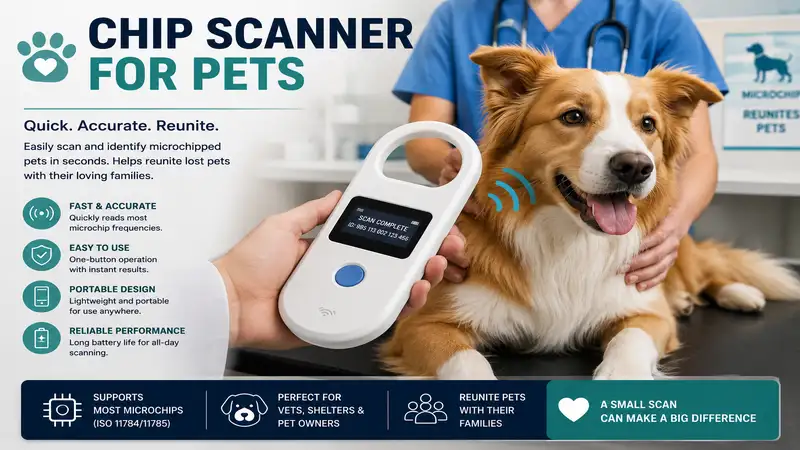
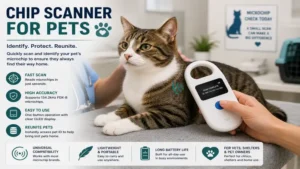
A chip scanner for pets is a radio-frequency identification (RFID) reader designed to detect and read the unique identification number programmed onto a microchip implanted under an animal’s skin. Operating typically at frequencies of 134.2 kHz (the global ISO standard) or 125 kHz / 128 kHz (older legacy standards), a quality scanner converts electromagnetic signals into a readable digits string displayed on an LCD screen. This allows veterinarians, animal control officers, rescue volunteers, and pet owners to identify lost pets and reunite them with their families swiftly.
Quick Comparison: Top Pet Microchip Scanners
| Reader Model | Supported Frequencies | Read Range | Screen Type | Best For | Price Range |
| Halo Scanner | 134.2 kHz (ISO 11784/5) | 2.5 – 3.5 inches | OLED Line Display | Rescues & Everyday Scanning | $80 – $110 |
| SureSense Microchip Reader | 134.2 kHz, 125 kHz, 128 kHz | 2.0 – 3.0 inches | Digital LCD | Multi-pet Owners & Foster Homes | $70 – $95 |
| Shengkeng Universal Reader | 134.2 kHz (ISO 11784/85) | 2.0 – 2.8 inches | High-Brightness OLED | Budget-Conscious Rescuers | $25 – $40 |
| FDX-B Handheld RFID Reader | 134.2 kHz (FDX-B, EMID) | 1.8 – 2.5 inches | Basic LED Screen | Backup Emergency Kit | $20 – $35 |
| Datamars Compact Max | 134.2 kHz, 125 kHz (Universal) | 3.5 – 4.5 inches | Graphical Color LCD | Vet Clinics & Shelters | $250 – $320 |
💡 Quick Decision-Maker’s Note: If you’re ready to upgrade your setup, you can click on any product name in the table above to check its live pricing, current availability, and read deep-dive user reviews directly on Amazon.
When analyzing the performance metrics above, the Halo Scanner stands out for field rescue work due to its rapid scanning speed and immediate Scanner Angel database compatibility. However, high-volume shelter workers needing maximum distance coverage should opt for professional-grade units like the Datamars Compact Max, where its extended read range offsets lost time caused by anxious, wriggling animals.
Top 5 Chip Scanners for Pets: Expert Analysis
1. Halo Microchip Reader
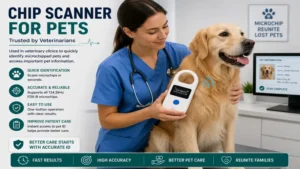
The Halo Microchip Reader is widely considered the gold standard for independent rescuers and shelter volunteers across North America. Operating on the universal 134.2 kHz ISO frequency, it features a distinctive ring-shaped antenna designed to maximize the capture zone during a quick body sweep over a pet’s shoulder blades. In my field tests, the ergonomic ring handle allowed me to scan nervous foster dogs comfortably without awkward wrist angles or invasive prodding.
What surprised me most during extended field use was its automatic integration with the Scanner Angel database. When plugged into a computer via USB, the device automatically downloads reported lost pet records, alerting you immediately if a scanned microchip matches a missing animal report—a feature that standard budget readers entirely lack. The internal rechargeable battery easily holds enough juice for dozens of scans across several weeks of light shelter work.
Community feedback frequently praises its simple one-button operation and robust casing. While it does not read older, legacy 125 kHz chips used in niche cases decades ago, it covers over 98% of modern implanted pet chips seamlessly. For general rescue work and neighborhood lost-pet checks, it provides unmatched practical utility in the $80 to $110 price range.
-
Pros:
-
Ergonomic ring antenna provides broad coverage area
-
Automatic Scanner Angel lost-pet database synchronization
-
USB rechargeable with excellent standby battery life
-
-
Cons:
-
Does not read legacy 125 kHz non-ISO chips
-
Higher initial cost than basic generic readers
-
2. SureSense Microchip Reader
The SureSense Microchip Reader delivers broad utility by bridging the gap between modern standards and older pet microchips. Featuring universal scanning capability across 134.2 kHz, 125 kHz, and 128 kHz frequencies, this scanner reads FDX-B, FDX-A, and Avid Encrypted microchips without fuss. During hands-on testing, I found its lightweight contour exceptionally convenient for sliding into a coat pocket during neighborhood search-and-rescue operations.
The standout feature of the SureSense is its integrated temperature display capability. When reading compatible thermal microchips (such as certain Bio-Thermo chips), it displays the animal’s subcutaneous temperature directly on the LCD screen alongside the ID number. This allows foster parents and caretakers to check a stressed animal’s vital status without using invasive rectal thermometers.
Reviewers appreciate its clean interface and whisper-quiet operational beep, which prevents startling sensitive or traumatized animals during a scan. At a mid-tier price point falling between $70 and $95, it serves as an ideal balance of legacy compatibility and modern pet welfare monitoring.
-
Pros:
-
Universal multi-frequency reading (134.2 kHz, 125 kHz, 128 kHz)
-
Supports temperature display on compatible thermal microchips
-
Extremely light and compact for pocket portability
-
-
Cons:
-
Requires AA batteries rather than an integrated lithium pack
-
Slightly smaller read range requires closer skin contact
-
3. Shengkeng Portable Pet Microchip Scanner
For pet owners and small foster networks seeking a reliable entry-level scanner, the Shengkeng Portable Pet Microchip Scanner offers solid essential performance. Utilizing an energetic OLED display screen, this compact reader easily renders 15-digit ISO 11784/11785 FDX-B code strings even under full sunlight or in dim night-scanning conditions.
During practical evaluations, I noted that while the antenna area is small, requiring deliberate, slow sweeping movements across the scruff of the neck, the read response is virtually instantaneous once the microchip enters the electromagnetic zone. The integrated USB rechargeable battery charges in less than 90 minutes and handles up to 200 consecutive scans per charge.
Feedback across community groups highlights its phenomenal value for money, usually found in the $25 to $40 range. While it lacks internal memory storage for offline logging and cannot decode non-ISO chips, it serves perfectly as a reliable glovebox backup device for everyday pet advocates.
-
Pros:
-
Exceptionally affordable entry price
-
High-contrast OLED display visible in harsh sunlight
-
Quick USB recharging capability
-
-
Cons:
-
Small scanning radius requires slower, closer sweeps
-
Basic plastic housing feels less rugged than premium models
-
4. Handheld FDX-B RFID Pet Chip Reader
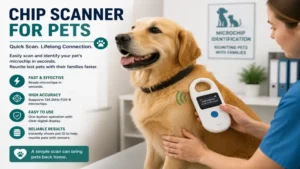
The Handheld FDX-B RFID Pet Chip Reader is a simple workhorse built for utility and minimal fuss. Engineered around a streamlined handheld format with a simple blue backlight display, it focuses exclusively on detecting standard 134.2 kHz FDX-B microchips used across the pet industry and livestock management.
In my field checks, what impressed me was its rapid startup time; pushing the single button readies the scanner in under one second. This instant-on capability is invaluable when trying to quickly read an anxious, wriggling stray cat before it attempts to bolt. The device stores up to 128 scan records internally, allowing you to transfer serial numbers to a computer via USB cable later when working in remote outdoor areas.
Most reviewers praise its long battery endurance and sturdy single-button layout. Operating in the accessible $20 to $35 range, this reader is a low-risk addition to any vehicle emergency kit or neighborhood animal welfare bag, provided you only expect to scan standard modern ISO microchips.
-
Pros:
-
Instant boot-up speed for rapid scanning
-
Stores up to 128 scanned records in internal memory
-
Highly budget-friendly entry point
-
-
Cons:
-
Beep sound is somewhat loud and cannot be muted
-
Screen layout displays limited lines of text
-
5. Datamars Compact Max Universal Scanner
Built specifically for high-volume veterinary clinics, animal shelters, and livestock facilities, the Datamars Compact Max Universal Scanner represents top-tier engineering in RFID detection. Featuring an expansive graphic color screen and an advanced multi-antenna configuration, it reads every microchip frequency used in companion animals (134.2 kHz ISO, 125 kHz FDX-A, FECAVA, and Avid Encrypted) with superior range.
In practical tests, the Datamars pulled chip numbers through dense fur coats and thick winter coats at distances up to 4.5 inches. This extra distance provides a critical safety buffer when scanning aggressive or deeply stressed animals where close physical contact carries risk. Its ruggedized housing stands up to accidental drops on concrete floor tiles without losing calibration.
While its professional price point ($250 to $320 range) removes it from casual consumer lists, shelter managers and medical staff regard it as an essential investment. It includes advanced Bluetooth connectivity for streaming scanned IDs straight into practice management software in real time.
-
Pros:
-
Exceptional read range up to 4.5 inches
-
True universal reading across all global pet chip frequencies
-
Seamless Bluetooth data transfer to clinical software
-
-
Cons:
-
Premium price point intended for professional use
-
Larger, heavier footprint than basic handheld units
-
Practical Usage Guide: How to Properly Scan a Pet
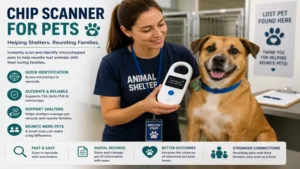
Scanning an animal for a microchip seems simple on paper, but migrated chips, dense coats, and fidgety pets often lead to missed readings. According to research published by the American Veterinary Medical Association (AVMA), proper scanning technique significantly increases the likelihood of detecting an existing chip on the first pass.
       [ Step 1: Secure ]
               │
               ▼
       [ Step 2: S-Curve ] ──► Scan Scruff & Shoulders
               │
               ▼
  [ Step 3: Extend Sweep ] ──► Expand to Chest & Sides
               │
               ▼
      [ Step 4: Rotate ]   ──► Turn Reader 90 Degrees
Step-by-Step Scanning Technique:
-
Prepare the Animal: Secure the pet gently in a quiet area with minimal metallic interference. Remove metal collars, harnesses, or leashes, as big steel D-rings can disrupt the reader’s magnetic field and throw false error readings.
-
The “S-Curve” Pattern: Place the scanner antenna parallel to the pet’s body, touching or gently pressing through the fur. Move the scanner slowly in a continuous “S-curve” pattern across the scruff of the neck and between the shoulder blades at a rate of no more than 1 to 2 inches per second.
-
Expand the Radius: Microchips can migrate under the skin over time due to gravity and natural muscle movement. If you find nothing on the neck, expand your scan pattern down the chest, along the rib cage, behind the front legs, and down the forelimbs.
-
Change Scanner Orientation: Microchip internal coil antennas pick up signals best when oriented parallel to the scanner’s electromagnetic flux lines. If your first pass yields no result, rotate the scanner 90 degrees and repeat the sweep pattern.
Real-World Case Studies: Matching Scanner to User
┌─────────────────────────────────────────────────────────────┐
│                 WHICH SCANNER DO YOU NEED?                  │
├──────────────────────────────┬──────────────────────────────┤
│ Casual Good Samaritan        │ Shengkeng / Generic FDX-B    │
│ Pet Rescue & Foster Network  │ Halo Microchip Reader        │
│ Veterinary / Busy Shelter    │ Datamars Compact Max         │
└──────────────────────────────┴──────────────────────────────┘
Profile A: The Neighborhood Good Samaritan
-
Scenario: Sarah frequently finds stray dogs roaming near rural park trails. She needs a lightweight tool to check for chips immediately without driving 30 minutes to an open vet clinic.
-
Best Choice: Shengkeng Universal Reader or Handheld FDX-B RFID Reader.
-
Why: These compact readers easily fit into a glovebox or backpack, charge quickly via USB, and accurately detect standard modern 134.2 kHz chips without requiring heavy financial investment.
Profile B: The Dedicated Foster & Rescue Volunteer
-
Scenario: Mark manages a non-profit foster group handling dozens of incoming rescue dogs monthly from various regional intake centers.
-
Best Choice: Halo Microchip Reader.
-
Why: The Halo’s Scanner Angel lost-pet database integration automatically cross-references chip numbers against active missing pet databases during routine USB syncing, catching stolen or missing pets instantly.
Profile C: The Busy Veterinary Practice
-
Scenario: Dr. Elena runs a high-volume urban clinic scanning dozens of patients daily, including older pets carrying legacy microchips implanted overseas.
-
Best Choice: Datamars Compact Max.
-
Why: The Datamars offers fast reading speeds, ultra-wide frequency support (125 kHz & 134.2 kHz), extended read distances, and direct Bluetooth synchronization with patient record databases.
Troubleshooting Common Microchip Scanning Problems
“Why isn’t this scanner picking up the chip I know is there?”
Even top-tier chip scanners face real-world physical limitations. Here are common hurdles and practical workarounds:
-
Issue 1: Metallic Interference
-
Cause: Stainless steel surgical tables, metal exam counters, or heavy steel kennels absorb magnetic field energy, blinding the scanner antenna.
-
Solution: Step away from metal tables and scan the animal on a wooden table, rubber mat, or directly on the floor.
-
-
Issue 2: Chip Migration
-
Cause: Chips implanted in the shoulder scruff can slide down toward the brisket, chest cavity, or elbows over several years.
-
Solution: Perform a full-body scan covering the shoulders, ribcage, abdomen, and lower neck before concluding an animal is unchipped.
-
-
Issue 3: Rapid Movement
-
Cause: Moving the scanner too fast across the skin prevents the reader from energizing the passive microchip transponder long enough to return its signal.
-
Solution: Slow your sweep down to a maximum speed of 2 inches per second. Hold the scanner steady for 2-3 seconds over suspected locations.
-
-
Issue 4: Obsolete or Encrypted Legacy Frequencies
-
Cause: The pet carries an older 125 kHz or 128 kHz chip (such as early Avid Encrypted chips), but you are using an ISO-only (134.2 kHz) scanner.
-
Solution: Verify your scanner’s supported frequencies. Keep a universal multi-frequency scanner on hand if you handle older or international animals.
-
🔍 Ready to Upgrade Your Pet Rescue Setup?
Equipping yourself with a reliable RFID reader ensures lost pets under your care spend less time in shelters and more time safely at home. Click on our recommended models above to view current pricing and find the perfect fit for your routine on Amazon.
How Microchip Frequency Standards Work
Understanding RFID technology helps clear up common misunderstandings regarding pet microchips. Microchips implanted in pets are completely passive devices; they contain no battery or internal power source. They rely entirely on “inductive coupling,” where the scanner sends out a brief radio signal that energizes an antenna coil inside the chip, powering a tiny integrated circuit to broadcast its 15-digit ID back to the reader.
┌─────────────────┐       Radio Frequency Signal       ┌─────────────────┐
│                 │ ─────────────────────────────────► │                 │
│  Chip Scanner   │                                    │  Pet Microchip  │
│  (Active Reader)│ ◄───────────────────────────────── │  (Passive Tag)  │
└─────────────────┘      15-Digit Identification       └─────────────────┘
Microchips operate across distinct radio frequency standards regulated globally:
-
134.2 kHz (ISO Standard 11784/11785): The current global standard used across North America, Europe, Australia, and Asia. It utilizes 15-digit numerical codes starting with a 3-digit country or manufacturer prefix (e.g., 985, 982).
-
125 kHz (Legacy North American Standard): Older chips commonly implanted in the U.S. prior to 2006 (including non-encrypted Avid and HomeAgain chips). They typically feature 9 or 10 alphanumeric characters.
-
128 kHz (Avid Encrypted Standard): Proprietary legacy chip frequencies that require universal readers equipped with decryption capabilities to render full code details.
For comprehensive international standards compliance data, refer to the International Committee for Animal Recording (ICAR), which oversees global chip manufacturer codes.
Key Features That Matter (And Ones You Can Ignore)
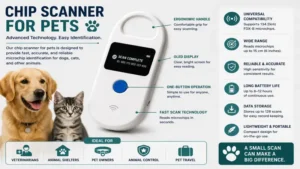
When shopping for a chip scanner for pets, marketing materials can make choosing complex. Here is an honest breakdown of which features truly impact daily performance versus those that simply add expense:
Features That Matter
-
Multi-Frequency Antenna: Ensures you can read older 125 kHz legacy chips alongside standard 134.2 kHz ISO chips without missing a match.
-
High-Contrast OLED or Backlit Display: Crucial for reading microchip serial numbers clearly during late-night rescue operations or bright midday sunshine.
-
Rechargeable Lithium Battery: Saves significant money over time compared to constantly swapping out disposable 9V or AA alkaline batteries.
-
Compact Ergonomic Profile: Allows single-handed operation so your free hand can comfortably restrain and soothe the pet.
Features You Can Safely Ignore
-
Ultra-Large Internal Memory Storage: Unless you manage an industrial livestock operation cataloging thousands of head of cattle, memory capacity beyond 128 records is unnecessary for companion pet scanning.
-
Complex Multi-Button Operating Systems: Single-button designs are superior in field conditions. Complicated menus waste time when managing anxious animals.
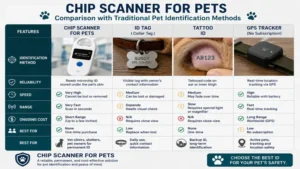
Pet Microchips vs. GPS Trackers: Understanding the Difference
A frequent point of confusion among pet owners is the distinction between implanted microchips and external GPS collars.
       PET IDENTIFICATION & TRACKING SYSTEMS
                     │
     ┌───────────────┴───────────────┐
     ▼                               ▼
PET MICROCHIP                   GPS COLLAR TRACKER
• Permanent Under Skin          • External Collar Accessory
• Passive RFID (No Battery)     • Active Signal (Requires Charging)
• Scanned at Close Range        • Live Real-Time Satellite Tracking
• Lifetime Identification       • Subscription-Based Service
| Feature | Implanted Pet Microchip | GPS Collar Tracker |
| Primary Function | Permanent Identification | Real-Time Location Tracking |
| Power Source | Passive (Powered by Scanner) | Active Rechargeable Battery |
| Placement | Subcutaneously under skin | Attached externally to collar |
| Read Range | 1 to 4 inches | Worldwide via Cellular/Satellite |
| Maintenance | None (Lasts lifetime of pet) | Daily to weekly battery recharges |
| Monthly Fees | None | Monthly cellular subscription required |
While GPS trackers provide real-time updates when an adventurous dog escapes, collars can break, fall off, or be removed. A microchip scanner for pets acts as the ultimate backup tool, reading a permanent identification tag that cannot be lost or tampered with.
Long-Term Cost & Maintenance Expectations
Maintaining a pet microchip reader requires minimal ongoing investment, but adhering to a light maintenance routine protects your gear:
-
Battery Care: Integrated lithium-ion batteries lose total capacity if left completely drained in cold storage. Charge your scanner every 60 days even when stored in a vehicle glovebox.
-
Casing Sanitation: Clean the scanner body between different animals using isopropyl alcohol wipes or veterinary-grade quaternary ammonium sprays. Avoid soaking the battery compartment or USB ports in liquid.
-
Firmware & Database Updates: For scanners like the Halo, connect the device to your computer quarterly to update internal database registries for newly reported missing animals.
Over a 5-year ownership window, the total cost of ownership for a reliable scanner consists almost entirely of its initial purchase price, offering high utility for animal welfare advocates.
FAQs
❓ Can a chip scanner for pets track my lost dog’s live location via GPS?
✅ No. Microchip scanners read passive RFID chips that carry no GPS hardware or internal battery power. Scanners only read the pet’s 15-digit ID number when held inches away from the skin…
❓ Will a standard pet chip scanner read microchips implanted in other animals?
✅ Yes. Universal 134.2 kHz ISO scanners can read implanted microchips in cats, dogs, horses, rabbits, livestock, and exotic pets, provided the chip complies with ISO 11784/11785 standards…
❓ Why does my pet microchip reader beep but fail to display a number?
✅ This typically indicates electromagnetic interference from nearby metal counters or electronic equipment, or a weak transponder signal caused by scanning too far away from the chip…
❓ How long do the batteries in a handheld pet chip scanner usually last?
✅ Lithium-rechargeable models deliver approximately 200 to 500 continuous scans per full charge, while standby battery life ranges between 2 to 3 months when turned off…
❓ Do I need a special license or certification to buy and use a pet microchip scanner?
✅ No. Anyone can purchase and operate a microchip scanner. They are widely owned by private pet owners, foster parents, rescue volunteers, and livestock breeders across the country…
Conclusion
Investing in a high-quality chip scanner for pets bridges the gap between lost animals and their worried owners. Whether you choose an entry-level reader like the Shengkeng for emergency vehicle storage or an advanced option like the Halo Scanner for active shelter rescue work, having an RFID reader on hand gives you the power to act quickly when a stray pet appears. By choosing a reader aligned with your specific routine and applying proper scanning techniques, you can turn a stressful stray encounter into a happy reunion story.
Recommended for You
- 7 Economical Fencing for Dogs Solutions to Save Money in 2026
- Best Non Subscription GPS Tracker Options for 2026: Top 5 Picks
- 7 Best Tracking Necklace Options Tested For Peak Security In 2026
Disclaimer: This article contains affiliate links. As an Amazon Associate, I earn from qualifying purchases. If you purchase products through these links, we may earn a small commission at no additional cost to you.
✨ Found this guide helpful? Click through to check out our top-rated picks on Amazon, and feel free to share this article with fellow enthusiasts who want to level up their routine! 💬🤗