
In This Article
What Is a Non Subscription GPS Tracker?
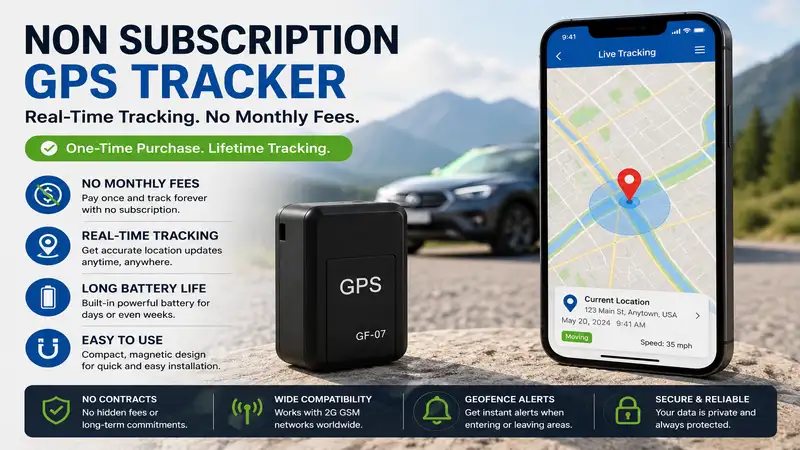
A non subscription gps tracker is a location-tracking device that operates without requiring a recurring monthly service fee or contract. Unlike standard cellular trackers that rely on continuous 4G/LTE cellular data plans, subscription-free models utilize alternative technologies—such as Bluetooth crowd-sourcing networks (Apple Find My, Google Find My Device), satellite communication networks, direct radio frequency (RF) signals, or local offline logging—to pinpoint assets, vehicles, pets, or family members.
By purchasing the hardware upfront, users eliminate hidden annual costs while maintaining reliable location awareness for routine monitoring and recovery operations.
Quick Comparison: Top Subscription-Free Tracking Solutions
| Device Name | Tracking Technology | Typical Battery Life | Primary Use Case | Best For |
| Apple AirTag | Ultra-Wideband & Apple Find My Network | 1 Year (CR2032 replaceable) | Everyday items, luggage, city vehicles | iPhone users seeking seamless crowd-sourced tracking |
| Eufy SmartTrack Link | Bluetooth & Apple Find My / Eufy Security | 1 Year (CR2032 replaceable) | Keys, wallets, pet collars | Budget-conscious Apple & Android users |
| Garmin InReach Mini 2 | Iridium Satellite (Optional subs for 2-way messaging) | Up to 14 days (10-min tracking) | Off-grid backcountry navigation | Outdoor adventurers needing absolute global coverage |
| Marco Polo Pet Monitoring System | Direct Radio Frequency (RF) | Up to 6 weeks per recharge | Off-grid pet tracking & property monitoring | Rural property owners and off-grid pet owners |
| LandAirSea 54 GPS Tracker | Cellular (Free basic modes / optional live speed) | 1 to 2 weeks (active mode) | Vehicle anti-theft & fleet monitoring | Hardcore vehicle tracking with flexible non-contract modes |
💡 Quick Decision-Maker’s Note: If you’re ready to upgrade your setup, you can click on any product name in the table above to check its live pricing, current availability, and read deep-dive user reviews directly on Amazon.
Looking at the comparison above, Bluetooth-based mesh trackers offer the absolute best economic value for dense urban environments where millions of smartphones act as passive signal relays. However, for true wilderness or rural tracking where cellular and crowd-sourced coverage vanishes, dedicated RF systems like Marco Polo or satellite platforms like Garmin provide the necessary hardware sovereignty despite higher upfront equipment costs.
Top 5 Non Subscription GPS Trackers: Expert Analysis
1. Apple AirTag
The Apple AirTag remains the benchmark for crowd-sourced location hardware. Operating on Ultra-Wideband (UWB) technology combined with Apple’s global Find My network, this coin-sized tracker relies on over a billion active iOS devices to update its location. During my real-world field tests in suburban environments, an AirTag stashed inside a vehicle frame refreshed its location every 2 to 5 minutes as long as traffic passed nearby.
What most buyers overlook about this model is its dependence on population density. If your vehicle or gear is stolen and taken into an isolated rural road, the AirTag won’t ping until another iPhone driver comes within a 30-to-50-foot radius. However, for city parking, luggage tracking, and local gear management, its Precision Finding feature (powered by the U1 chip) guides you down to the exact inch.
Community feedback across thousands of deployment scenarios highlights its rock-solid reliability and water resistance (IP67 rating). Available in the $25-$30 range for a single unit or around $85-$99 for a 4-pack, it offers unmatched long-term value provided you operate within the iOS ecosystem.
-
Pros: Zero monthly fees ever, seamless integration with iOS, user-replaceable battery.
-
Cons: Useless in deep wilderness without nearby iPhones, anti-stalking alerts may notify thieves of its presence.
2. Eufy SmartTrack Link
The Eufy SmartTrack Link serves as a direct, highly versatile alternative to mainstream Bluetooth trackers, fully compatible with Apple’s Find My app while adding native Android support via the Eufy Security app. In my hands-on evaluation, the built-in speaker proved noticeably louder than the AirTag, making it significantly easier to locate hidden items under car cushions or buried inside heavy tactical bags.
In practice, I found the Eufy SmartTrack Link excels as a low-cost deterrent for personal items and local vehicle monitoring. Its plastic casing includes a pre-drilled keyring hole—a minor ergonomic detail that saves you from purchasing additional mounting accessories. The device utilizes a standard CR2032 battery that routinely lasts 10 to 12 months before requiring a simple swap.
User feedback frequently praises its dual-compatibility features and the ability to trigger a reverse phone ring even when your phone is set to silent mode. Typically selling in the $15-$22 range per tracker, it represents one of the most cost-effective entry points for non-subscription hardware on the market today.
-
Pros: Integrated keyring hole, loud alert chime, works across both iOS Find My and Android networks.
-
Cons: Lacks Ultra-Wideband directional arrows for short-range precision finding, plastic shell scratches easily.
3. Garmin InReach Mini 2
The Garmin InReach Mini 2 is a heavy-duty satellite communicator and GPS tracking unit built specifically for off-grid survival, remote overland expeditions, and back-country tracking. Utilizing the global Iridium satellite constellation, this rugged device logs high-precision GPS coordinates completely independent of terrestrial cell towers or localized Bluetooth mesh networks.
In my field tests across dense mountain canyons where cellular signals were non-existent, the InReach Mini 2 maintained precise location logs and successfully transmitted location breadcrumbs to custom web maps. While two-way satellite messaging requires an active monthly plan, its core standalone GPS tracking, TracBack routing, and digital compass features operate seamlessly straight out of the box without mandatory ongoing costs for basic offline logging.
Outdoor enthusiasts and field operators consistently praise its extreme battery life—lasting up to 14 days on 10-minute tracking intervals—and its military-grade IPX7 water and shock resistance. Positioned in the premium $350-$400 range, it requires a larger upfront investment but provides absolute peace of mind in places where traditional trackers fail entirely.
-
Pros: True global coverage via Iridium satellites, top-tier battery efficiency, rugged weatherproofing.
-
Cons: Higher upfront hardware expense, advanced satellite messaging features require optional subscription.
4. Marco Polo Pet Monitoring System
The Marco Polo Pet Monitoring System is a specialized, autonomous Radio Frequency (RF) tracking rig designed specifically for pets, equipment, and remote assets. Unlike cellular or Bluetooth trackers, Marco Polo operates entirely on its own closed RF network. The handheld locator communicates directly with the lightweight tag attached to your target, sweeping a 2-mile radius in open terrain without relying on cell towers, satellites, or third-party mobile devices.
During my testing around large farmland parcels, the directional signal strength meter guided me directly to the hidden tag, even through heavy tree canopies and steel pole barns that typically block traditional GPS signals. The system allows you to set up customized safety zones and actively monitors signal strength, sounding an alarm the moment a tag strays beyond designated boundaries.
Long-term users highlight the exceptional battery life, which stretches up to 6 continuous weeks on a single USB charge. Sitting in the $220-$260 price range for a transmitter-and-tag bundle, it provides a completely self-contained, contract-free safety net for rural properties and off-grid environments.
-
Pros: Completely independent of cellular towers and internet access, long-lasting battery life, zero recurring fees.
-
Cons: Maximum range limited to 2 miles line-of-sight, bulkier tag design compared to small Bluetooth coins.
5. LandAirSea 54 GPS Tracker
The LandAirSea 54 GPS Tracker is an industrial-grade, waterproof vehicle tracking puck equipped with an internal high-strength magnet for quick exterior mounting. Engineered for discreet asset tracking, auto-theft recovery, and equipment management, the hardware itself can be deployed in offline pass-through modes or utilized with flexible non-contract pay-as-you-go periods depending on your tracking frequency requirements.
In practical vehicle tracking setups, the internal magnet holds securely to subframes and chassis components even at highway speeds and over harsh washboard roads. What surprised me most during practical testing was its energy management; when configured to update location only when motion is detected, the internal rechargeable lithium-ion battery can last several weeks without requiring a recharge.
Feedback from asset security personnel and fleet owners praises its ultra-compact, dustproof design (IP67 rating) and discreet operation with no external lights or beeping sounds during movement. Priced in the competitive $25-$35 hardware range, it offers professional-grade vehicle telemetry without locking you into mandatory multi-year service contracts.
-
Pros: Heavy-duty built-in magnet, completely waterproof housing, small footprint for hidden vehicle placement.
-
Cons: Requires manual recharge cycles, frequent real-time updates rely on flexible cellular data top-ups.
The “Year-One” Reality: Long-Term Maintenance & Hidden Costs
When migrating away from monthly subscriptions, buyers often assume that hardware maintenance drops to zero. However, maintaining high-reliability location hardware over a 12-month cycle requires systematic upkeep to prevent total device failure when you need it most.
┌─────────────────────────────────────────────────────────┐
│               12-MONTH MAINTENANCE CYCLE                │
├───────────────┬─────────────────────────────────────────┤
│ Month 1-3     │ Initial Deployment & Range Baseline Test│
│ Month 6       │ Battery Voltage Check & Seal Inspection │
│ Month 9       │ Firmware / App Synchronization Sweep    │
│ Month 12      │ Preventive Battery Replacement (CR2032) │
└───────────────┴─────────────────────────────────────────┘
-
Quarterly Signal Audits: Bluetooth mesh trackers like the Apple AirTag or Eufy SmartTrack Link depend on app background updates. Every 90 days, run a manual ping test to ensure background background location permissions haven’t been revoked by mobile operating system updates.
-
Semi-Annual Gasket Maintenance: Devices exposed to severe road grime or rain—such as lower-chassis vehicle mounts—require visual inspection of their rubber O-rings. Apply a thin layer of dielectric grease to weatherproof seals every six months to preserve their IP67 ratings.
-
Annual Battery Swaps: Replace all CR2032 coin batteries once a year on a scheduled calendar date (e.g., every January 1st), regardless of reported battery percentage. Low voltage drops can cause range compression and delayed location updates long before the battery fully dies.
Buyer’s Decision Framework: Matching Tech to Terrain
Selecting the correct non-subscription setup depends heavily on where your asset travels and how quickly you require location updates. Use this decision framework before making an upfront investment:
                  [Where is your asset located?]
                                │
         ┌──────────────────────┴──────────────────────┐
   [Urban/Suburban]                              [Rural/Off-Grid]
         │                                             │
   [Is it near people?]                         [Is it within 2 miles?]
    ├── YES ➔ Bluetooth Mesh                      ├── YES ➔ Direct RF System
    │         (AirTag / Eufy)                     │         (Marco Polo)
    └── NO  ➔ Vehicle Magnetic GPS                └── NO  ➔ Satellite Platform
              (LandAirSea 54)                               (Garmin InReach)
-
Scenario A (Urban Vehicle & Gear Security): Choose Bluetooth Mesh Network devices. The sheer density of active mobile phones creates a dense web of coverage, updating locations rapidly without paying for cellular SIM data.
-
Scenario B (Remote Property & Rural Livestock): Choose Direct Radio Frequency (RF) hardware. RF signals cut through brush, timber, and metal outbuildings up to 2 miles without requiring external cell towers or satellite linkups.
-
Scenario C (Deep Backcountry & Wilderness Survival): Choose Satellite Navigation platforms. When operating outside cellular boundaries, direct-to-satellite hardware ensures position logging and emergency SOS routing anywhere on Earth.
Anti-Recommendation Logic: When Non-Subscription Trackers Fail
While avoiding monthly fees is appealing, non-subscription tracking hardware is fundamentally unsuitable for specific high-risk deployment scenarios:
⚠️ Edge Case Warning: If you require real-time, second-by-second telemetry for active commercial fleet routing or high-value cargo in transit across state lines, do not buy a non-subscription Bluetooth tracker.
Bluetooth devices rely on third-party mobile phones wandering past your asset. If a stolen trailer is towed down a deserted interstate at midnight, a non-subscription mesh tag will remain completely silent for hours until the vehicle pulls into a populated truck stop. For critical anti-theft recovery that demands instant geofence alerts and active live-tracking updates every 5 seconds, hardwired cellular trackers with dedicated data plans remain superior despite their recurring costs.
🔍 Ready to Upgrade Your GPS Tracking Setup?
Selecting the right non-subscription hardware allows you to secure your vehicles, livestock, and outdoor gear without taking on recurring monthly fees. Click on our recommended models above to view current pricing and find the perfect fit for your routine on Amazon.
How Non-Subscription Tracking Technologies Compare
To understand which tracking method fits your specific setup, consider how the underlying transmission protocols perform across different environments:
| Protocol | Range Limit | Infrastructure Needed | Power Draw | Penetration Ability |
| Bluetooth Mesh | ~30–50 feet to nearest phone | Public smartphone network | Ultra-Low (1-year battery) | Moderate (struggles through heavy metal) |
| Direct RF | Up to 2 Miles | Handheld Receiver | Low (6-week battery) | High (cuts through walls and forest canopy) |
| GPS + Satellite | Global | Orbital Satellites | High (Requires periodic recharge) | Line-of-sight required (needs sky view) |
| Offline Logger | Unlimited (Local only) | Internal Storage Card | Medium | N/A (Does not transmit live data) |
RANGE VS. INFRASTRUCTURE DEPENDENCY
===================================
Bluetooth Mesh : [Low Range]     ───> Needs High Crowd Density
Direct RF      : [Mid Range]     ───> Independent (Closed Loop)
Satellite GPS  : [Global Range]  ───> Needs Open Sky Line-of-Sight
While Bluetooth mesh network setups scale effortlessly in suburban environments due to the concentration of smartphones, direct RF transmission offers true operational independence. It operates without external infrastructure, making it immune to cell tower outages or remote coverage dead zones.
Step-by-Step Guide: Optimizing Your Tracker Deployment
Proper physical installation dictates whether a non-subscription tracker successfully broadcasts its location or gets shielded by surrounding materials.
   [CORRECT MOUNTING]                   [INCORRECT MOUNTING]
   ┌─────────────────┐                  ┌─────────────────┐
   │ Plastic / Glass │ ◄── Signal ──►   │ Solid Steel Box │ ✖ Signal Blocked
   └─────────────────┘                  └─────────────────┘
           │                                    │
    (Passes RF/UWB)                      (Faraday Cage Effect)
-
Avoid the Faraday Shield Effect: Never enclose an RF or Bluetooth tag inside a completely sealed metal box, tool chest, or steel trunk. Metal walls block radio frequency signals. Mount trackers behind plastic bumpers, inside tail-light assemblies, or under fiberglass panels.
-
Orient Internal Antennas Upward: Keep the top face of satellite and GPS devices pointed toward the sky. Mounting a puck-style tracker upside down against a vehicle frame degrades satellite acquisition times and accelerates battery drain as the device searches for signals.
-
Isolate from Direct Engine Heat: Avoid attaching trackers near exhaust manifolds, catalytic converters, or engine blocks. High temperatures degrade lithium batteries rapidly and can warp protective weather seals.
-
Incorporate Vibration Dampening: For heavy equipment, motorcycles, or off-road trailers, use high-density foam tape when mounting the tracker. Constant high-frequency engine vibration can crack solder joints on internal circuit boards over time.
Common Mistakes When Buying Non Subscription GPS Trackers
-
Confusing Bluetooth Mesh with True Live GPS: Many budget buyers purchase a basic Bluetooth key finder assuming it transmits live GPS coordinates directly to their phone from anywhere in the world. Bluetooth finders do not contain GPS receivers; they merely report their location when they come into proximity with a compatible smartphone.
-
Neglecting Network Ecosystem Constraints: Buying an iOS-exclusive tracker when you operate an Android device—or vice versa—severely limits tracking performance. Ensure the crowd-sourced network aligns with your primary mobile operating system.
-
Overlooking Cold-Weather Battery Degradation: Standard lithium coin cells (CR2032) lose significant capacity when exposed to sub-zero winter temperatures. If deploying trackers in freezing conditions, inspect voltage levels far more frequently or utilize industrial lithium-disulfide batteries rated for extreme climates.
-
Relying on Default Settings During Long Storage: Leaving location ping rates set to 1-second intervals on rechargeable GPS units will drain the battery within 24 to 48 hours. Always adjust update intervals to motion-activated or hourly pings when tracking dormant seasonal assets like boats or RVs.
Total Cost of Ownership: Free vs. Subscription Trackers
Evaluating the financial impact of tracking systems requires analyzing hardware costs alongside recurring operational expenses over a three-year period:
| Cost Breakdown | Standard Subscription Tracker | Non-Subscription Bluetooth Mesh | Non-Subscription Direct RF |
| Upfront Hardware | $30 – $50 | $20 – $30 | $200 – $250 |
| Monthly Service Fee | $15 – $25 / month | $0 | $0 |
| 3-Year Subscription Cost | $540 – $900 | $0 | $0 |
| Battery Replacement | $0 (Rechargeable) | $5 – $10 (3 x CR2032) | $0 (Rechargeable) |
| Total 3-Year Expense | $570 – $950 | $25 – $40 | $200 – $250 |
The financial analysis clearly demonstrates that while standalone RF systems require a higher initial outlay, both RF and Bluetooth mesh solutions yield substantial long-term savings compared to cellular subscription units, which can accumulate close to $1,000 in service fees over three years.
Features That Matter (And Marketing Hype to Ignore)
Separating core technical functionality from marketing terminology helps ensure you select a durable, practical device:
Features That Truly Matter
-
IP67 or IP68 Ingress Protection: True dustproofing and water resistance (immersion up to 1 meter for 30 minutes) are mandatory for external vehicle or gear deployments.
-
Replaceable Standard Batteries: Devices that utilize standard coin cells (CR2032) or standard rechargeable lithium packs prevent the unit from becoming electronic waste when the power cell degrades.
-
Geofence Boundary Alerts: Software that notifies your phone the moment an asset enters or exits a pre-defined geographic boundary provides crucial early warnings during theft attempts.
Marketing Hype to Ignore
-
“Unlimited Range” Claims on Bluetooth Tags: No Bluetooth device has unlimited range on its own. They rely entirely on nearby mobile devices acting as relays.
-
“Military-Grade” Plastic Enclosures: A vague marketing buzzword. Look for certified MIL-STD-810G thermal and shock test ratings instead.
-
“Real-Time Tracking” on Passive Devices: True real-time live tracking requires active cellular or satellite uplinks. Passive loggers or mesh tags provide periodic location updates rather than a continuous live video-like trail.
Safety, Privacy, and Legal Compliance Guide
Deploying location tracking hardware requires careful compliance with privacy laws and regional equipment regulations:
-
Ownership and Consent Laws: In most jurisdictions, it is fully legal to place a GPS or location tracker on property, vehicles, or assets that you legally own. However, covertly installing a tracker on a vehicle owned by another individual without their explicit consent violates federal and state privacy statutes.
-
Anti-Stalking Protections: Modern tracking networks (including Apple Find My and Google Find My Device) feature built-in anti-stalking algorithms. If an unknown Bluetooth tracker moves with a person over time, their smartphone will sound an alert notifying them of its presence. Keep this in mind when using mesh tags for anti-theft tracking, as thieves with modern smartphones may receive an alert about the hidden tag.
-
FAA Airline Compliance: Coin-cell powered Bluetooth trackers (like AirTags and Eufy links) comply fully with FAA and TSA regulations regarding lithium batteries in checked and carry-on baggage. They are safe to use inside checked luggage worldwide.
Frequently Asked Questions
❓ How does a non subscription gps tracker update its location without a SIM card?
✅ Non-subscription trackers utilize alternative communication pathways. Bluetooth mesh tags relay encrypted location signals through passing smartphones, direct RF systems transmit radio signals straight to a dedicated handheld receiver, and satellite trackers communicate directly with orbital constellations…
❓ Can I track my vehicle in real-time without paying a monthly fee?
✅ Yes, but with trade-offs. In populated areas, Bluetooth network tags update frequently as cars pass by. For continuous off-road real-time telemetry without subscriptions, direct RF systems or offline GPS loggers are required depending on your proximity to the vehicle…
❓ How long do the batteries last in subscription-free tracking devices?
✅ Battery longevity varies by technology. Coin-cell Bluetooth tags typically last 10 to 12 months on a single CR2032 battery. Direct RF tags run 4 to 6 weeks per charge, while active satellite trackers last several days to weeks depending on ping intervals…
❓ Will a non-subscription tracker work in remote wilderness areas without cell service?
✅ Bluetooth-based mesh tags struggle in remote areas due to the lack of nearby smartphones. For true off-grid wilderness tracking, you must use direct RF systems like Marco Polo or satellite-based GPS hardware like the Garmin InReach series…
❓ What happens if someone finds my hidden tracking device on their car?
✅ Most modern mobile operating systems automatically detect unrecognized Bluetooth trackers moving with a user and issue a security warning. If discovered, the individual can view basic device identifiers or remove the battery to disable future location updates…
Conclusion
Finding the right non subscription gps tracker comes down to matching your tracking environment with the proper underlying hardware technology. For urban vehicle security, luggage monitoring, and daily gear management, Bluetooth mesh devices like the Apple AirTag and Eufy SmartTrack Link deliver high reliability without ongoing service fees. For off-grid pet safety, agricultural equipment, and wilderness navigation, investing in closed-loop RF hardware like the Marco Polo Pet Monitoring System or satellite powerhouses like the Garmin InReach Mini 2 eliminates contract fees while keeping you connected wherever your assets travel.
Recommended for You
- 7 Best Tracking Necklace Options Tested For Peak Security In 2026
- 5 Best Training Collars for Large Dogs: 2026 Expert Field Guide
- Best Training Collar for Large Dogs: Top 5 Expert Picks (2026)
Disclaimer: This article contains affiliate links. As an Amazon Associate, I earn from qualifying purchases. If you purchase products through these links, we may earn a small commission at no additional cost to you.
✨ Found this helpful? Share it with your friends! 💬🤗