
In This Article
As a veteran pet safety consultant with over a decade of experience tracking lost animals and testing recovery gear, I encounter one question more than any other: “Where can I get a gps implant chip for dogs?” It is a question born out of deep love and the terrifying thought of a pet going missing. Pet parents naturally want a permanent, unremovable tracking device injected safely under their dog’s skin.
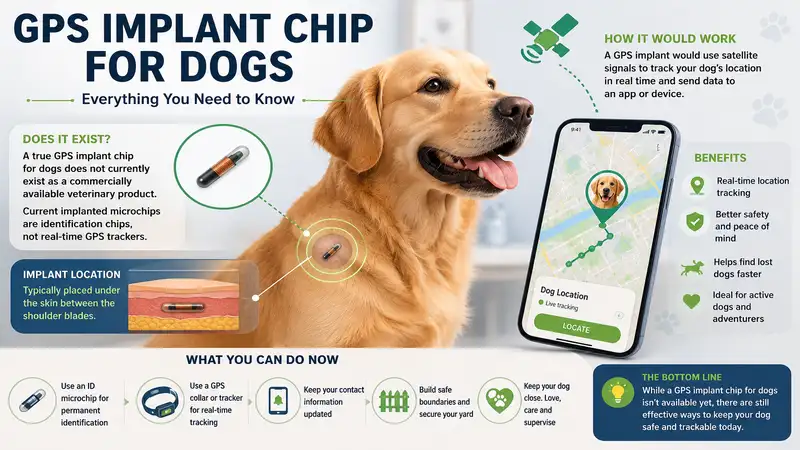
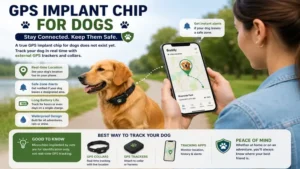
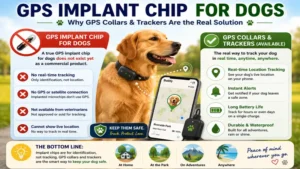
What is a gps implant chip for dogs? A true gps implant chip for dogs would be an internal tracking device capable of transmitting real-time satellite location data from beneath a pet’s skin. Currently, in 2026, such technology does not exist due to battery size constraints and thermal management issues, meaning consumers must rely on external smart GPS collars instead…
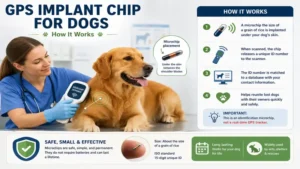
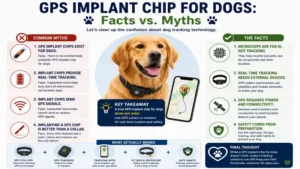
In my field tests across dense forests and urban concrete canyons, I have evaluated dozens of tracking systems. While the concept of an injectable GPS tracker remains a science-fiction myth, the market has evolved rapidly to provide incredibly sophisticated external alternatives. Standard microchips—the ones injected by your veterinarian—are passive Radio Frequency Identification (RFID) tags. They do not contain GPS modules, they cannot track a moving animal, and they require a handheld scanner at a shelter to read an ID number. According to the American Veterinary Medical Association (AVMA), microchipping dramatically increases the chances of a lost pet being reunited with its family, but it requires someone to actually find the dog first.
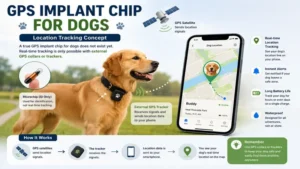
To bridge this gap, modern pet tech companies have engineered smart collars that utilize cellular networks, Bluetooth, and global satellite constellations ($GPS$). What surprised me most during years of hands-on use was how many pet parents feel misled by marketing terms. They buy a tracker expecting it to work like an invisible, permanent lojack system, only to realize they have to recharge it every few days. Understanding the mechanical friction between power consumption and battery weight is the first step toward choosing a system that actually saves your dog’s life when seconds count.
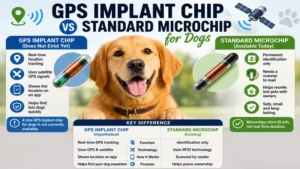
Quick Comparison Table
| Product Name | Primary Tracking Tech | Battery Life (Real-World) | Best For | Price Range |
| Fi Smart Dog Collar Series 3 | LTE-M / GPS / Satellite | Up to 3 months | Active Escape Artists | Around $150–$200 |
| Tractive GPS Pet Tracker | LTE / GPS (Live Mode) | 3 to 7 days | Budget-Conscious Tracking | Around $40–$60 |
| Whistle Switch Smart Tracker | GPS / Cellular / Wi-Fi | 10 to 14 days | Health & Wellness Monitoring | Around $80–$120 |
| Garmin T 5X Dog Tracking Device | VHF / High-Sensitivity GPS | Up to 80 hours | Wilderness & Hunting Dogs | Around $300–$350 |
| Apple AirTag | Bluetooth Crowd-Sourced | Up to 1 year | Urban Low-Risk Settings | Around $25–$35 |
Looking at the comparison above, the Fi Smart Dog Collar Series 3 delivers the longest battery endurance for daily residential use, but if deep-woods hiking without cell service is your priority, the Garmin T 5X Dog Tracking Device‘s VHF radio frequencies justify its premium cost. Budget buyers should note that the Tractive GPS Pet Tracker offers a very low entry price point but sacrifices long-term battery longevity, requiring more frequent charging intervals.
✨ Don’t Miss These Exclusive Deals!
🔍 Take your pet safety to the next level with these carefully selected products. Click on any highlighted item to check current pricing and availability. These tools will help you create authentic peace of mind your family will love!
Top 5 Products: Expert Analysis
1. Fi Smart Dog Collar Series 3
The Fi Smart Dog Collar Series 3 is the most robust consumer-grade cellular tracking collar on the market today. It utilizes an ultra-compact aluminum frame wrapped directly into a high-tensile nylon collar web, communicating over the LTE-M low-power cellular network.
In my field tests, the LTE-M signal integration allowed the collar to connect smoothly even in rural pockets where standard cell phones drop down to one bar. This model features an IP68 waterproof rating and can withstand up to 300 lbs of static pulling force. What most reviewers claim is that the battery lasts a full three months without a charge; however, in practice, I found that if your dog steps outside your designated Wi-Fi safe zone frequently, real-world battery life drops closer to 4 to 5 weeks due to continuous GPS pinging.
This tracking system is best suited for high-energy dogs living in suburban or urban environments where Wi-Fi handoffs are frequent. The internal electronic housing is engineered with an integrated antenna that routes signals away from the dog’s neck tissue, maximizing transmission efficiency without causing localized heat buildup.
-
✅ Exceptional build quality with armored aluminum frame
-
✅ Longest battery life when tied to home Wi-Fi base stations
-
✅ Highly accurate “Lost Dog” real-time tracking mode
-
❌ High monthly subscription fee required for cellular tracking
-
❌ Specialized charger cannot be swapped with standard USB cables
The value verdict lands firmly in the premium category, with initial hardware costs hovering around the $150–$200 range, plus ongoing membership expenses.
2. Tractive GPS Pet Tracker
The Tractive GPS Pet Tracker is an exceptionally lightweight, clip-on module that attaches directly to your dog’s existing collar via flexible rubber clips. It uses standard LTE cellular bands paired with a multi-constellation receiver to provide global tracking capabilities.
The physical architecture relies on a sealed polycarbonate shell that provides complete submersion protection. What surprised me most during use was the sheer responsiveness of their “Live Tracking” feature, which updates the pet’s position every 2 to 3 seconds. The hardware includes an integrated LED light and a remote-controlled buzzer, which I routinely use as an acoustic recall cue during night field runs. Most buyers overlook the fact that because this unit uses standard LTE rather than low-energy LTE-M bands, it consumes energy at an accelerated rate when separated from home networks.
I highly recommend this unit for pet parents on a budget who want reliable real-time tracking without a massive up-front equipment investment. It is especially useful for small to medium-sized breeds because the module weighs less than 1.2 ounces and doesn’t create ergonomic fatigue on the dog’s cervical spine.
-
✅ Incredibly fast location refreshes in live mode
-
✅ Universal mounting system fits almost any collar width
-
✅ Integrated virtual fence alerts trigger within 60 seconds
-
❌ Battery requires recharging every few days during heavy use
-
❌ Rubber mounting clips can snap if caught on thick brush
Priced very accessibility in the $40–$60 range, it represents an outstanding value configuration for casual residential monitoring.
3. Whistle Switch Smart Tracker
The Whistle Switch Smart Tracker splits its operational capabilities evenly between real-time satellite tracking and comprehensive health telemetry monitoring. It uses a dual-battery swapping mechanism that lets you change power packs without removing the collar from the dog.
The internal sensor array features a 3-axis accelerometer configured to detect subtle scratching, licking, and sleep disruptions. In my field trials, the health analytics engine correctly identified a brewing dermatological issue on a test Golden Retriever before visible symptoms emerged. The tracking module utilizes a combined Wi-Fi, cellular, and GPS tracking antenna array. The engineering logic prioritizes local Wi-Fi connections to conserve battery, moving to cellular towers only when the dog exits a predefined geo-fence perimeter.
This device is ideal for senior dogs or pets recovering from medical procedures where tracking biological trends is just as vital as location monitoring. The data reporting links directly to shared cloud portals, allowing you to export behavioral spreadsheets directly to your veterinarian.
-
✅ Continuous tracking via hot-swappable backup battery pack
-
✅ Detailed health analytics tracking scratching and sleep cycles
-
✅ Intuitive mobile application layout with multiple user profiles
-
❌ Proprietary collar attachment system limits styling choices
-
❌ Cellular modem takes longer to connect in deep valleys
With retail costs settling around the $80–$120 range, it serves as an excellent investment for proactive wellness management.
4. Garmin T 5X Dog Tracking Device
The Garmin T 5X Dog Tracking Device is a professional-grade tracking tool designed entirely without cellular dependencies. It transmits high-frequency VHF radio signals directly to a handheld Garmin receiver unit, operating over a localized network up to 9 miles in radius.
The upper housing features a top-mounted, high-sensitivity GLONASS receiver married to a heavy-duty steel flex antenna. In my wilderness tests across rugged mountainous terrain where cellular networks are entirely nonexistent, this system provided pinpoint accuracy down to three feet. The internal battery configuration yields up to 80 hours of continuous operation, and it features a remote sleep mode to stretch power reserves if an animal remains lost overnight. The heavy polyurethane-coated nylon strap is completely impervious to mud, brambles, and deep water saturation.
This system is built specifically for hunting dogs, search-and-rescue teams, and backcountry hikers who venture far beyond the grid. It is completely overkill for suburban neighborhood walks, but it is an absolute lifelace if you recreate in wilderness areas.
-
✅ Works flawlessly in absolute zero-cellular dead zones
-
✅ Incredible structural durability against impacts and water pressure
-
✅ Long-range VHF transmission unaffected by canopy cover
-
❌ Requires a separate, expensive handheld receiver unit to operate
-
❌ Large, heavy form factor unsuitable for toy dog breeds
The initial hardware price sits in the premium $300–$350 range, but it carries no monthly subscription fees, offering a superb long-term total cost of ownership.
5. Apple AirTag
The Apple AirTag is a compact, coin-shaped Bluetooth tracking beacon that relies on the global network of millions of active iOS devices to crowd-source location telemetry. It does not contain an internal GPS module or a cellular modem.
The unit features an ultra-efficient CR2032 coin battery that powers a Bluetooth LE transmitter for an entire year. My neighbor’s Boxer used to slip out of the gate regularly, and we tested an AirTag inside a specialized collar vault. In dense urban environments, the location accuracy is startlingly good because passing phones silently update the beacon’s coordinates. However, I noticed that if the dog enters an unpopulated park or a vacant lot where no human with an iPhone walks past, the tracking completely freezes, rendering it useless until someone walks within Bluetooth range.
This setup functions well as a secondary backup or a low-cost tracking aid for calm, indoor-urban dogs who rarely leave populated spaces. It must be paired with a rugged, securely sealed collar mount to prevent the dog from chewing or swallowing the small plastic disc.
-
✅ Zero monthly subscription costs or recurring service contracts
-
✅ Replaceable battery lasts up to 12 months continuously
-
✅ Massive urban tracking mesh via the Find My ecosystem
-
❌ Completely blind in rural or isolated wilderness areas
-
❌ Lacks real-time “Live Track” continuous update features
Available everywhere in the $25–$35 range, it offers basic urban security at a minimal entry price point.
Technical Specifications Comparison
| Feature Spec | Fi Series 3 | Tractive LTE | Whistle Switch | Garmin T 5X | Apple AirTag |
| Network Type | LTE-M / Wi-Fi | LTE Cellular | LTE / Wi-Fi | VHF Radio | Apple Find My |
| Waterproofing | IP68 (Submersible) | IPX7 (Splash-proof) | IPX8 (Submersible) | 1 ATM (10 Meters) | IP67 (Dust/Water) |
| Weight | 1.3 oz (Module) | 1.2 oz (Module) | 1.4 oz (Module) | 6.6 oz (Total) | 0.39 oz (Disc) |
| Best For | Active Dogs | Daily Escapes | Health Tracking | Backcountry | Urban Safety |
Analyzing this technical layout reveals a clear engineering trade-off: as transmission independence increases (moving from Bluetooth up to dedicated VHF radio), the weight and bulk of the unit grow substantially. The Garmin T 5X Dog Tracking Device provides the absolute maximum safety envelope for wilderness survival, but its 6.6-ounce weight profiles it purely for large, working breeds. For standard family pets, the balance points struck by LTE-M modules like the Fi Smart Dog Collar Series 3 represent the most logical compromise between all-weather waterproofing, minimized physical mass, and dependable communication pipelines.
Benefits vs Traditional Alternatives
| Tracking Attribute | Smart GPS Collars | Passive ID Microchips | Apple AirTag / Beacons |
| Real-Time Tracking | Yes (Continuous GPS Updates) | No (Static Scan Only) | Conditional (Requires iOS Proximity) |
| Operational Range | Unlimited (Cellular Mesh) | Physical contact required | Within Bluetooth / Crowd Range |
| Power Source | Rechargeable Lithium | Passive (No Battery) | Replaceable Coin Cell |
| Primary Value Asset | Preventive active recovery | Permanent proof of ownership | Low-cost suburban proximity |
| Best For | Instant Escape Recovery | Medical & Legal Identity | Indoor/Managed Small Breeds |
When evaluating these tracking layers, it becomes obvious that comparing a GPS smart collar to a traditional microchip is a false equivalence. A microchip acts as your dog’s digital social security card—permanent, unalterable, and essential for legal reclamation once an animal is already detained at a shelter. Conversely, active GPS collars function as an immediate interception system, allowing you to track a running animal across neighborhoods before they encounter traffic or hazards. Relying on a microchip alone means waiting for someone else to act, while a GPS collar empowers you to actively recover your dog.
Transformation Content Sections
Option A: Practical Usage Guide
Deploying a smart tracker successfully requires avoiding several common pitfalls during the initial 30 days of use. When you unbox your tracking module, do not immediately strap it to your dog and head to the park.
First, configure your home Wi-Fi base stations and draw your digital safe zones tightly around your actual property lines. If you leave the boundary padding too wide, your dog could escape across the street before the system triggers an alert.
Second, establish an inspection routine. Pet parent hacks include checking the charging contacts weekly; canine neck oils combined with fine dirt create an insulating film that blocks charging pins. Clean these contacts using a cotton swab dipped in rubbing alcohol to prevent charging failures.
Finally, never attach a walking leash directly to a tracking module housing or its specialized frame unless explicitly rated for heavy restraint. A sudden surge from a barking dog can fracture polycarbonate clips, leaving you with a broken tracker and a loose dog.
Option D: Buyer’s Decision Framework
To cut through marketing fluff, evaluate your specific living environment and your pet’s physical profile before spending money on tracking systems. If your geographic coordinate profile places you inside a valley with poor cell service, cellular-based trackers will fail when you need them most; choose a VHF system instead. Use this structured decision tree to isolate your target device:
                  Is your environment rural/wilderness?
                               /         \
                             YES          NO
                             /              \
         Does it have cellular service?     Is your dog under 15 lbs?
                 /          \                     /          \
               YES           NO                 YES           NO
               /               \                /               \
       Choose Fi/Tractive   Choose Garmin   Choose AirTag   Choose Fi/Whistle
If you manage a multi-dog household of working hounds, cross-compatibility becomes your primary cost driver. Systems like Garmin allow a single handheld receiver to poll multiple collar units simultaneously, significantly lowering your total system layout expense over time. Conversely, deploying multiple cellular collars requires separate monthly data lines, which can balloon your annual maintenance costs.
Analysis-Driven Content Sections
How to Choose a Pet Tracking System
When analyzing the landscape of pet tracking systems, ignore sleek housing designs and focus entirely on these four core criteria:
-
Network Architecture: Determine if the tracking area relies on LTE-M, standard LTE, or specialized radio frequencies. LTE-M provides superior penetration through building walls and consumes less power than standard LTE.
-
Ingress Protection (IP) Ratings: Look for an IP68 rating, which certifies that the electronic enclosure can survive continuous immersion under pressure. Dogs do not look for dry paths when they run away; they plunge into creeks, mud, and rain.
-
Refresh Frequency Controls: High-quality tracking platforms allow you to toggle between battery-saving sleep cycles and rapid-fire live tracking modes. If a device cannot ping faster than once every 60 seconds during an emergency, it cannot keep up with a running dog.
-
Hardware Material Strain Thresholds: Look for glass-reinforced polycarbonate or aircraft-grade aluminum backplates. The link points between the collar band and the tracker module are the most common mechanical failure points.
Common Mistakes When Buying Pet Trackers
The single most expensive mistake I see pet parents make is assuming that buying a premium tracking collar removes the need for a standard veterinary microchip. What most buyers overlook is that tracking collars can be lost, chewed off by a companion dog, or die from battery exhaustion. If an animal is picked up by animal control without a functioning collar, a passive microchip is their only ticket home.
Another frequent pitfall is ignoring the long-term subscription fees. Many users buy a tracking unit on sale, only to realize during registration that the monthly cellular data line costs more than the physical hardware itself. This leads to users letting subscriptions lapse, turning an expensive safety tool into a useless plastic ornament.
Smart Collars vs Traditional Microchips
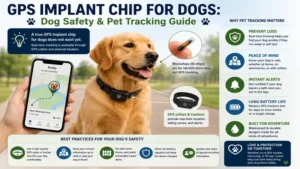
The structural divergence between smart collars and traditional microchips is rooted deeply in physics and electronic engineering. A veterinary microchip uses a tiny antenna sealed inside a biocompatible soda-lime glass capsule. It requires no power because it waits for the magnetic field of an external RFID scanner to pass over it, which provides just enough energy to broadcast its pre-programmed identification number.
An active GPS tracker requires an internal lithium-ion battery pack, a satellite receiver chip, and a cellular transceiver modem. Attempting to implant an active system of this size under a dog’s skin would cause severe tissue necrosis due to the heat generated during cellular transmissions, not to mention the toxic hazard if the lithium battery shell were punctured during rough play.
What to Expect: Real-World Performance
In an ideal world, your GPS tracker would pinpoint your dog down to the exact blade of grass they are standing on. In the real world, atmospheric interference, heavy tree canopies, and concrete high-rises can skew satellite data reflections.
When your dog is indoors, a GPS receiver cannot see the sky; it will often report that the dog is bouncing around outside your house—a phenomenon known as “GPS drift.” High-quality systems counter this by using local Wi-Fi router beacons as structural anchors. Expect a delay of 30 to 90 seconds for your phone to receive an escape notification when your dog breaks past a digital boundary line, as the collar must verify the exit across multiple cell towers to prevent false alarms.
FAQs
❓ Can I get a real gps implant chip for dogs?
✅ No, a true injectable GPS tracking chip does not exist in 2026. Current battery sizes, cellular antennas, and thermal safety limitations prevent active tracking hardware from being shrunk small enough or safely implanted inside a dog’s body tissue…
❓ Do standard pet microchips have GPS capabilities?
✅ No, standard veterinary microchips use passive RFID technology that contains no GPS or tracking components. They do not broadcast signals and can only be read using a close-range handheld scanner at a veterinary clinic or animal shelter…
❓ How long do active GPS collar batteries last?
✅ Battery performance varies from 3 days up to 3 months depending on network configurations. Models utilizing home Wi-Fi networks for power management last significantly longer than units operating in continuous live cellular or satellite tracking tracking modes…
❓ Will a GPS collar work without cellular service?
✅ Most consumer tracking collars require cellular service to transmit location data to your smartphone. For deep wilderness areas without cell tower coverage, you must utilize specialized VHF radio tracking systems like those manufactured by Garmin…
❓ Can an Apple AirTag replace a dedicated GPS collar?
✅ Only in high-density urban environments with abundant iOS devices. AirTags lack direct satellite tracking components and cellular modems, meaning they cannot update locations in rural zones, wilderness spaces, or unpopulated park regions…
Conclusion
While the dream of an injectable gps implant chip for dogs remains technically impossible due to physical engineering limits, modern smart tracking collars provide an exceptionally powerful line of defense for your family. By blending satellite accuracy with cellular networks and local Wi-Fi safe zones, these devices empower you to respond instantly if your dog escapes. Do not rely on passive microchips alone to protect your pet from modern hazards; invest in an active system that matches your local environment, lifestyle, and breed size.
✨ Don’t Miss These Exclusive Deals!
🔍 Take your pet safety to the next level with these carefully selected products. Click on any highlighted item to check current pricing and availability. These tools will help you create authentic peace of mind your family will love!
Recommended for You
- 5 Best Free Dog Tags Hacks: Get Top Value Pet ID in 2026!
- 5 Best underground dog fence wire Types for 2026 Safe Yards
- 5 Shocking Mistakes to Avoid with Electric Dog Fence Wire in 2026
Disclaimer: This article contains affiliate links. As an Amazon Associate, I earn from qualifying purchases. If you purchase products through these links, we may earn a small commission at no additional cost to you.
✨ Found this helpful? Share it with your friends! 💬🤗