
In This Article
Understanding the Backbone of Invisible Fencing
When you first commit to an electronic containment system, it is easy to fixate on the transmitter or the collar’s corrective settings. However, in my decade of experience as a pet containment consultant, I have learned that the entire layout is only as reliable as the boundary itself. The dog wire—the literal lifeline of your containment setup—is the component most susceptible to environmental degradation, physical damage, and signal attenuation. What is a dog wire? Simply put, it is an underground radio antenna that transmits a localized signal to your pet’s receiver collar, establishing a safe boundary zone without the need for a physical, visible barrier.
What many owners fail to realize is that the standard wire included with most starter kits is often a thin, 20-gauge copper-clad aluminum (CCA) product designed for minimal cost rather than long-term resilience. If you live in an area with harsh winter freezes or highly acidic soil, that stock dog wire might start failing within two seasons. By selecting a high-quality, direct-burial rated gauge, you aren’t just buying wire; you are investing in peace of mind. In this guide, we will move past the marketing fluff to examine how specific materials and insulation ratings dictate the actual performance of your dog wire system. Whether you are installing a new layout or replacing a chewed-through section, understanding these technical nuances is the only way to avoid the dreaded “broken wire” alert.
Quick Comparison Table: Top Rated Dog Wire Options
| Product Name | Gauge | Jacket Type | Best For | Price Range |
| Extreme Dog Fence Pro | 14 AWG | Polyethylene | Heavy-duty/Long runs | $90–$150 |
| PetSafe Stubborn Dog Wire | 16 AWG | PVC | Standard yards | $40–$70 |
| EasyPet Fence Heavy Duty | 14 AWG | HDPE | Rocky/Wooded terrain | $80–$130 |
| Dig Defence Pro-Series | 18 AWG | Dual-Jacket | Temp repairs/Small areas | $30–$50 |
| Professional Grade Boundary | 14 AWG | XLPE | Commercial/Large plots | $110–$170 |
Quick Analysis
The data above highlights a clear trend: dog wire gauge matters more than anything else for long-term reliability. A 14-gauge dog wire provides significantly lower electrical resistance, ensuring the signal remains strong across larger perimeters. While the 16 and 18-gauge dog wire options are budget-friendly, they are best suited for smaller, manicured lawns where soil conditions are stable and non-abrasive.
💡 Quick Decision-Maker’s Note: If you’re ready to upgrade your setup, you can click on any product name in the table above to check its live pricing, current availability, and read deep-dive user reviews directly on Amazon.
Top 5 Dog Wire Solutions: Expert Analysis
1. Extreme Dog Fence Pro
This 14-gauge solid copper wire is the industry gold standard for a reason. Unlike cheaper CCA options, the solid copper core ensures maximum signal conductivity, even over plots exceeding 5 acres. The polyethylene jacket is rated for direct burial, which means it resists moisture ingress and rot much better than standard PVC.
In my experience, the stiffness of this 14-gauge wire can be a challenge when navigating sharp corners, but it prevents the “wire bunching” that often leads to internal fractures over time. It is ideal for homeowners who want a “set it and forget it” solution and aren’t afraid of a bit of labor during the installation process.
Community feedback consistently praises the lack of signal drops. Most users report that after switching to this from a stock system, their dog’s collar activates consistently at the boundary, rather than suffering from “dead zones.” Expect to spend in the range of $90–$150 depending on the spool length.
2. PetSafe Stubborn Dog Wire
Designed specifically for compatibility with the industry-leading PetSafe systems, this 16-gauge wire strikes a balance between flexibility and durability. The PVC jacket is easy to maneuver, making it my top choice for complex fence layouts that require tight curves or winding around garden beds.
While it lacks the heavy-duty weather protection of 14-gauge alternatives, it serves the majority of suburban users perfectly well. I usually suggest this for people who know their terrain is free of heavy rocks or high-activity zones where the wire might be snagged by lawn aeration tools.
User reviews often highlight how easy it is to strip the insulation when making splices, which is a major pain point for DIY installers. At an around $40–$70 price point, it is a sensible upgrade if your original starter wire has failed after 3–5 years.
3. EasyPet Fence Heavy Duty
This product uses High-Density Polyethylene (HDPE) insulation, which is vastly superior for resisting UV degradation and soil acidity. If you are burying your wire in a region with heavy clay or high iron content in the soil, this jacket will prevent the chemical breakdown that plagues standard insulation.
I have found this wire to be surprisingly supple for its gauge. It handles tension well, which is crucial if you are installing it alongside a traditional fence line where the wire needs to be pulled tight against posts. It is a premium product, typically found in the $80–$130 range.
Reviewers appreciate that it doesn’t “kink” when pulled from the spool. This sounds trivial, but if you have ever spent four hours fighting a twisted wire under your lawn, you know exactly why this is a massive pro.
4. Dig Defence Pro-Series
Marketed as a professional-grade alternative, this 18-gauge wire is perfect for smaller, temporary, or secondary containment zones. It features a dual-jacket construction that provides extra protection against physical nicks from lawn mowers or garden spades.
It’s important to manage expectations here: because it is 18-gauge, the resistance is higher, so it shouldn’t be used for massive perimeter loops. However, for a small front yard or a dog run, it is incredibly effective. It’s a great value pick in the $30–$50 price range.
The feedback indicates that users love the color-coded insulation, which helps in identifying lines if you have multiple containment zones. Just keep in mind that the thinner core means you shouldn’t stretch it as tightly as the 14-gauge options.
5. Professional Grade Boundary
Using Cross-linked Polyethylene (XLPE), this wire is built for extreme environments. XLPE insulation is significantly more heat-resistant and durable than standard polyethylene, making it the best choice if you live in the sun-drenched Southwest or areas with extreme seasonal temperature fluctuations.
What I appreciate most about this product is the attention to long-term signal integrity. The copper is oxygen-free, which reduces signal degradation over time—a technical detail that most manufacturers ignore but one that prevents the dreaded “beeping” in the collar when you’re nowhere near the fence. It sits in the $110–$170 range.
Reviewers are often professional contractors, which speaks volumes about its reliability. If you want the absolute longest lifespan possible for your system, this is the wire you want buried in your yard.
Ready to Upgrade Your Dog Wire Setup?
If your current boundary system feels inconsistent or you find yourself patching breaks every month, it is likely the wire itself failing under the stress of environmental wear. Investing in a thicker, properly insulated wire will ensure your pet remains safe and your signal remains sharp through every season. Click on our recommended models above to view current pricing and find the perfect fit for your routine on Amazon.
Practical Usage Guide: Mastering the Installation
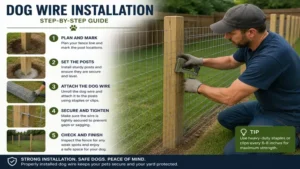
Most people think installation is just digging a shallow trench and burying the dog wire. In reality, proper installation involves managing tension and moisture. First, never pull the wire taut; give it a little “slack” every few feet to allow for ground shifting during freeze-thaw cycles. If you pull it like a guitar string, it will snap underground within two years.
Second, the weakest point of any system is the splice. When connecting new wire to old, use a waterproof, silicone-filled splice capsule. Twist the wires together securely before inserting them into the gel, and ensure no copper is exposed. Moisture ingress at the splice point is the #1 cause of false signals.
Finally, for the first 30 days, monitor your transmitter’s resistance gauge (if equipped). If the resistance numbers climb rapidly, you have a bad connection somewhere. Fixing this early prevents the system from burning out the transmitter’s signal generator, saving you from a much more expensive repair down the line.
Real-World Scenario: Which Wire Fits Your Life?
Choosing the right wire depends entirely on your yard and lifestyle. If you are a weekend hobbyist with a large, suburban plot and a moderately active dog, the Extreme Dog Fence Pro is your best friend. Its 14-gauge thickness is an insurance policy against the occasional spade nick or lawn aeration.
However, if you live in a dense townhouse complex with a small backyard, you don’t need the heavy-duty stuff. A 16-gauge wire, like the PetSafe Stubborn Dog Wire, offers all the performance you need without the unnecessary cost and the challenge of working with heavy, stiff cables in tight spaces.
For those in rural areas with rocky, uneven terrain, the EasyPet Fence Heavy Duty is non-negotiable. Rocks will shift and scrape the insulation of cheaper wires, causing a “ground fault” that is nearly impossible to track down. By spending a bit more on a rugged jacket now, you save yourself the “treasure hunt” of digging up 500 feet of wire next summer to find one small, rock-induced nick.
How to Choose the Right Gauge
Understanding wire gauge—measured in American Wire Gauge (AWG)—is fundamental when shopping for a dog wire. The lower the number, the thicker the dog wire. For pet containment layouts:
-
14 AWG Dog Wire: Best for long distances and harsh soil. Offers the lowest signal resistance across expansive boundaries.
-
16 AWG Dog Wire: The “Goldilocks” size for average, well-maintained lawns. Balanced flexibility and strength.
-
18 AWG Dog Wire: Fine for small, simple loops but this dog wire is prone to breakage if the ground shifts frequently.
Always evaluate your soil composition before purchasing your dog wire. If you have “boney” soil filled with flint or shale, prioritize a dog wire with a high-density polyethylene (HDPE) or cross-linked (XLPE) jacket. These materials are engineered to let your dog wire slide against jagged earth rather than snag and tear.
Common Mistakes When Buying
The biggest mistake I see when buyers source a replacement dog wire is “Mixing and Matching” metals. If you have an existing system that uses copper-clad aluminum dog wire and you repair it with solid copper dog wire, you can create a galvanic corrosion point at the splice, leading to rapid dog wire degradation. Always try to match the material of your original dog wire.
Another common blunder is ignoring the “Maximum Loop Length” rating of your transmitter when pairing it with a heavy dog wire. A 14-gauge dog wire allows you to run much longer loops than an 18-gauge dog wire, but if your transmitter isn’t designed to push that much signal, you will experience “ghosting” (where the dog wire signal fluctuates wildly). Always check your transmitter’s manual to see if it can handle the resistance drop of a thicker dog wire.
Long-Term Cost & Maintenance
The “Total Cost of Ownership” (TCO) for a pet containment system is often skewed by the choice of dog wire. Buying a $30 roll of budget dog wire might seem like a bargain, but if you have to replace that dog wire in two years, your labor cost and the price of a second roll make it the most expensive option.
Consider the “Efficiency Gap”: A premium 14-gauge dog wire runs cooler and carries signals with less distortion, which puts less strain on your transmitter. By investing in a better dog wire, you are extending the life of your entire electronic system, not just the boundary line. Maintenance for your dog wire is simple: once a year, walk the line and ensure no trees or shrubbery roots have grown over the path; roots are surprisingly good at slowly pulling a buried dog wire out of the ground.
Features That Actually Matter
Don’t be swayed by marketing terms like “ultra-sensitive” or “turbo-signal.” Those refer to the collar, not the dog wire itself. The only features that matter for your dog wire are:
-
Conductor Material: Solid copper dog wire is always better than CCA.
-
Jacket Composition: HDPE and XLPE offer the best resistance to moisture and UV rays on an exposed dog wire.
-
Gauge: 14 AWG dog wire for reliability, 16 AWG dog wire for convenience.
-
Rating: Ensure your chosen dog wire is explicitly “Direct Burial” rated. Never use indoor speaker wire as a dog wire, regardless of what an online forum might suggest; it will disintegrate in months.
FAQ: Common Questions About Boundary Wires
❓ Can I use any wire to replace my dog fence boundary?
✅ No, you must use a specific direct-burial rated wire. Standard electrical wire lacks the insulation properties required to prevent water ingress, which will lead to signal shorts and total system failure within a very short time…
❓ How deep should I bury the dog wire?
✅ Typically, 3 to 6 inches is sufficient. This protects the wire from lawn mowers and aerators while ensuring the signal remains strong enough to be detected by the collar. Deeper is not always better due to signal strength issues…
❓ Can I use two different brands of wire together?
✅ Yes, you can, provided they are the same gauge and material. If you mix copper and aluminum, use a high-quality, weather-proof, silicone-filled splice kit to prevent oxidation at the connection point, which can cause intermittent signal failure…
❓ Does the wire color matter?
✅ For functionality, no. However, choosing a wire that matches your soil color can make future maintenance slightly easier, and some pros prefer specific colors to distinguish between multiple zones in the same yard…
❓ What causes “broken wire” alerts if the wire looks fine?
✅ Often, the break is internal. A nick in the insulation leads to corrosion, which eventually eats through the metal core. These “invisible” breaks are best found using a professional wire-break locator tool rather than guesswork…
Conclusion
Your containment system is only as good as the path the signal travels. By choosing the right gauge and insulation for your specific soil type, you eliminate the most common failure points that plague DIY setups. Remember, this isn’t just about keeping the dog in the yard—it’s about creating a secure, reliable barrier that functions regardless of the weather or ground movement. Investing in higher-quality copper and specialized jackets today prevents a frustrating weekend of digging tomorrow.
✨ Found this guide helpful? Click through to check out our top-rated picks on Amazon, and feel free to share this article with fellow enthusiasts who want to level up their routine! 💬🤗
Recommended for You
- 5 Best Dog Shock Collar for Big Dogs Options (2026 Expert Guide)
- 5 Best Vibration Collars for Dogs: Expert 2026 Practical Training Guide
- Best Dog Collar with Nameplate: 5 Top Picks for 2026
Disclaimer: This article contains affiliate links. As an Amazon Associate, I earn from qualifying purchases. If you purchase products through these links, we may earn a small commission at no additional cost to you.
✨ Found this helpful? Share it with your friends! 💬🤗